

Introduction
The demand for a DevOps Automation Engineer has skyrocketed in recent years, and it continues to grow rapidly in 2026. With businesses shifting towards cloud computing, automation, and faster software delivery, companies are actively hiring professionals who can streamline development and operations. If you’re planning a career in IT or looking to switch roles, becoming a DevOps Automation Engineer can be one of the smartest decisions. This blog will guide you through everything – meaning, roles, skills, tools, salary, and roadmap – in a simple and practical way.
What is a DevOps Automation Engineer?
A DevOps Automation Engineer is a professional who automates the process of software development, testing, deployment, and monitoring using tools and scripts.
In simple terms:
A DevOps Automation Engineer ensures that software moves from development to production quickly, efficiently, and without errors.
Breaking the Term
- DevOps = Development + Operations
- Automation Engineer = Someone who automates repetitive tasks
So, a DevOps Automation Engineer is someone who automates the entire software lifecycle.
Role and Responsibilities
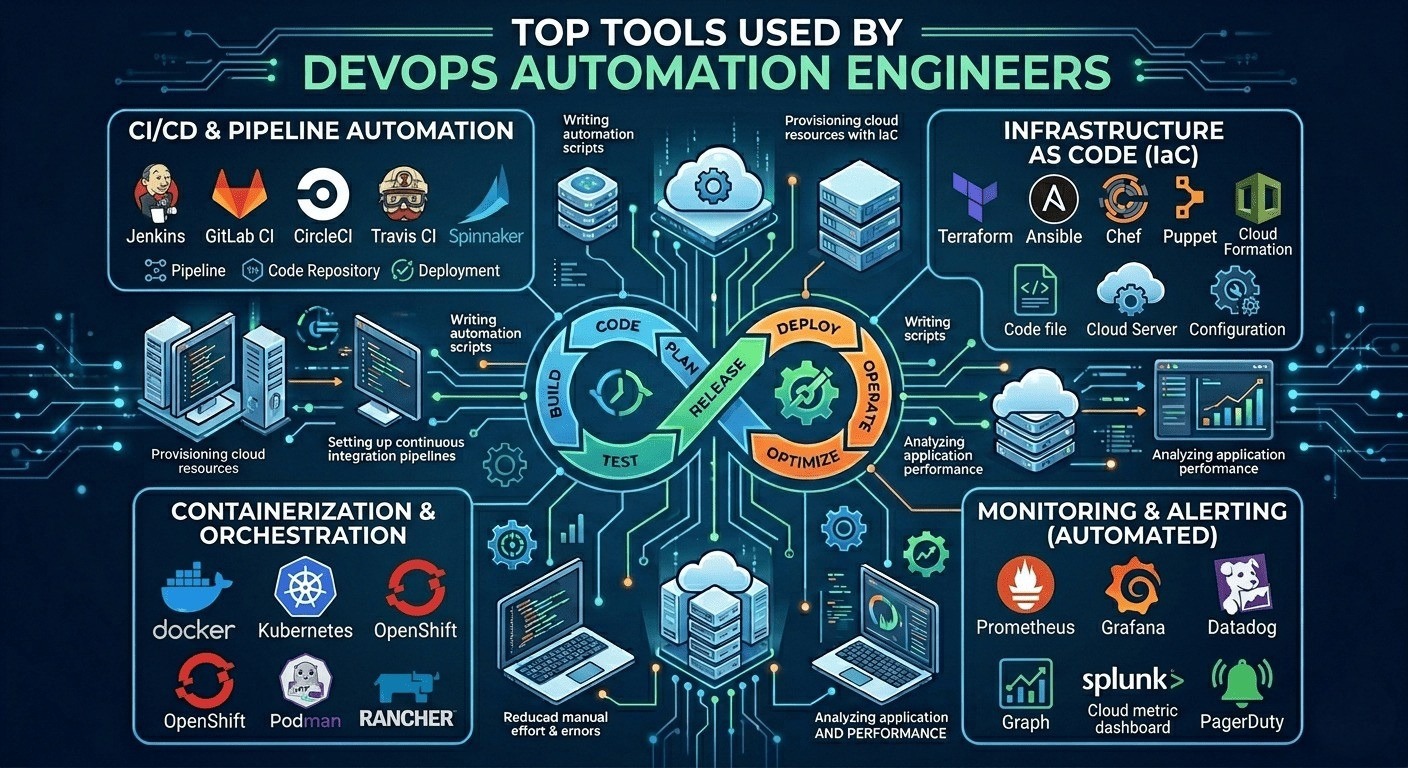
A DevOps Automation Engineer plays a critical role in modern IT teams. Here are the key responsibilities:
1. Build CI/CD Pipelines
They create automated pipelines to build, test, and deploy code using tools like Jenkins.
2. Automate Infrastructure
Using Infrastructure as Code (IaC), they automate server setup and configurations.
3. Manage Containers
They work with tools like Docker and Kubernetes to manage applications.
4. Monitor Applications
They track system performance using monitoring tools.
5. Collaborate with Teams
They bridge the gap between developers and operations teams.
Top Tools Used by DevOps Automation Engineers
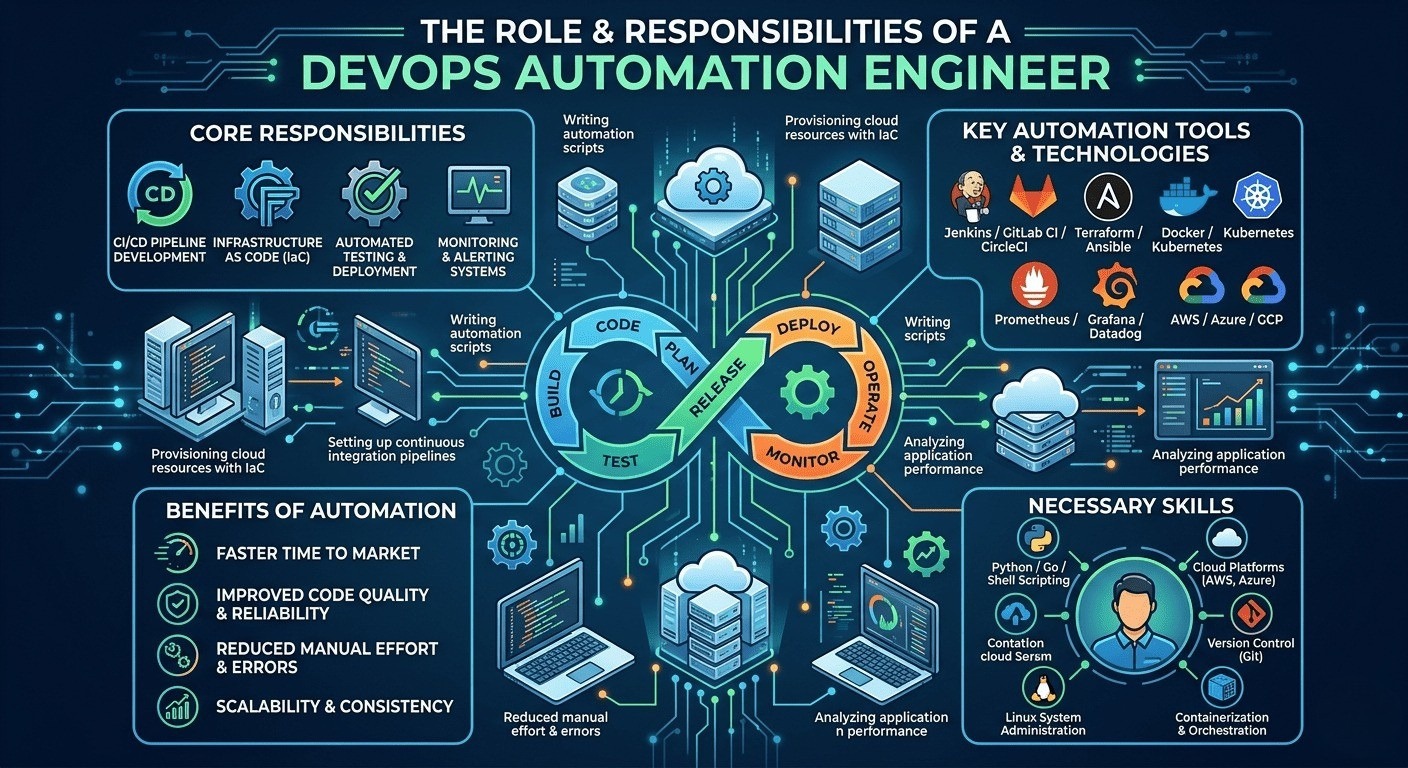
To become a successful DevOps Automation Engineer, you must learn the right tools:
CI/CD Tools
- Jenkins
- GitHub Actions
- GitLab CI
Containerization Tools
- Docker
Orchestration Tools
- Kubernetes
Version Control
- Git
Automation Tools
- Ansible
- Terraform
Monitoring Tools
- Prometheus
- Grafana
Skills Required to Become a DevOps Automation Engineer
To build a strong career, you need both technical and practical skills:
Technical Skills
- Linux & System Administration
- Networking basics
- Scripting (Python, Bash)
- Cloud Computing (AWS, Azure, GCP)
- CI/CD concepts
Soft Skills
- Problem-solving
- Communication
- Team collaboration
- Continuous learning mindset
DevOps Automation Engineer Roadmap (Step-by-Step)
Here’s a clear roadmap to become a DevOps Automation Engineer in 2026:
Step 1: Learn Linux Basics
Start with commands, file systems, and permissions.
Step 2: Learn Git & Version Control
Understand branching, merging, and repositories using Git.
Step 3: Learn Programming/Scripting
Focus on Python or Bash for automation.
Step 4: Understand CI/CD
Learn how pipelines work using Jenkins.
Step 5: Learn Docker
Containerize applications using Docker.
Step 6: Learn Kubernetes
Manage containers at scale using Kubernetes.
Step 7: Learn Cloud Platforms
Focus on AWS (most in demand).
Step 8: Work on Projects
Build real-world DevOps projects.
DevOps Automation Engineer Salary in India (2026)
Salary depends on skills, experience, and location:
- Freshers: ₹4–8 LPA
- Mid-Level: ₹8–15 LPA
- Experienced: ₹15–30+ LPA
With cloud and automation expertise, salaries can go even higher.
Career Scope
The future of DevOps is extremely promising:
✔ High demand in startups and MNCs
✔ Remote job opportunities
✔ Global career growth
✔ Integration with AI (AIOps)
Companies are constantly looking for professionals who can automate workflows and reduce deployment time.
Why Choose DevOps Automation Engineering as a Career with BinaryBrains?
Choosing DevOps Automation Engineering is already a smart move – but when you combine it with the right training partner like Binary Brains, it becomes a powerful career decision.
Here’s how
Fast-Growing Industry + Industry-Focused Training
DevOps is one of the fastest-growing fields in IT. With Binary Brains, you don’t just learn theory – you get industry-relevant training aligned with current market demand.
High Salary Packages + Job-Ready Skills
Companies pay high salaries for skilled DevOps professionals. BinaryBrains helps you build job-ready skills with real-world tools and practical exposure, increasing your chances of landing high-paying roles.
Global Opportunities + Advanced Tools Training
DevOps skills are in demand worldwide. At BinaryBrains, you learn tools like Docker, Kubernetes, and Jenkins, which are used by global companies.
Continuous Learning + Expert Mentorship
DevOps is all about continuous improvement. BinaryBrains provides expert mentorship, updated curriculum, and hands-on practice to keep you ahead in your career.
Automation + AI Integration + Future-Ready Skills
The future of DevOps lies in automation and AI. With BinaryBrains, you get exposure to modern automation practices and emerging technologies, making you future-ready.
Common Mistakes Beginners Should Avoid
- Skipping Linux basics
- Learning tools without understanding concepts
- Not building real projects
- Ignoring cloud platforms
- Focusing only on theory
DevOps Automation Engineer Projects for Practice
To stand out, build these projects:
- CI/CD pipeline using Jenkins
- Dockerized web application
- Kubernetes deployment
- Infrastructure automation using Terraform
- Monitoring setup with Prometheus & Grafana
Certifications for DevOps Automation Engineers
Certifications boost your credibility:
- AWS Certified DevOps Engineer
- Docker Certified Associate
- Kubernetes Certification (CKA)
- Azure DevOps Certification
DevOps Automation Engineer Interview Questions
Here are some common questions:
- What is CI/CD?
- Difference between Docker and Kubernetes?
- What is Infrastructure as Code?
- Explain DevOps lifecycle
- What is Jenkins pipeline?
DevOps Automation Engineer vs DevOps Engineer
Feature | DevOps Engineer | DevOps Automation Engineer |
Focus | Overall process | Automation |
Work | Manual + Automation | Mostly automation |
Tools | Basic tools | Advanced automation tools |
Role | Broad | Specialized |
Future of DevOps Automation Engineers
The future is evolving with:
- AI-powered automation
- Cloud-native applications
- Serverless computing
- DevSecOps (Security integration)
DevOps Automation Engineers will become even more valuable in the coming years.
Conclusion
One of the most in-demand roles in the IT industry today. With the right skills, tools, and practical knowledge, you can build a highly successful career in this field. If you are serious about entering the tech industry or upgrading your skills, now is the perfect time to start your DevOps journey.
Join Our:
Frequently Asked Questions
1. What is the salary of a DevOps Automation Engineer?
2. What is the job description of a DevOps Automation Engineer?
3. What is the salary of a DevOps Engineer?
4. What are some examples of DevOps automation?
Automated code testing and deployment (CI/CD pipelines) Infrastructure provisioning using scripts Automated monitoring and alert systems Container deployment using tools like Docker and Kubernetes
Comments are closed