

Introduction
The DevOps landscape is evolving rapidly, and Artificial Intelligence (AI) is at the center of this transformation. Organizations today are not only looking for professionals who can manage infrastructure, automate deployments, and maintain cloud environments—they are increasingly seeking engineers who can leverage AI to work smarter, automate repetitive tasks, and improve operational efficiency.
Additionally, with tools like ChatGPT, GitHub Copilot, and Amazon Q becoming part of daily workflows, the demand for professionals skilled in Generative AI for DevOps is growing faster than ever.
Whether you’re a student, IT professional, System Administrator, or aspiring Cloud Engineer, understanding how AI is reshaping DevOps can help you stay ahead in the job market.
In this article, we’ll explore how AI is transforming DevOps, the tools driving this change, the future skills employers are looking for, and why combining AI with DevOps is becoming one of the most demanding career paths in technology.
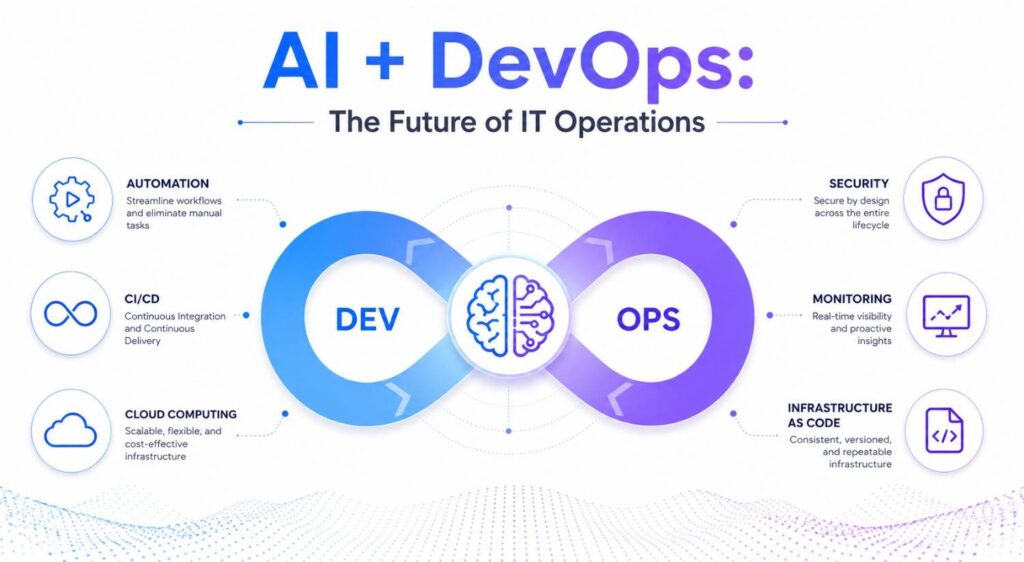
What is AI DevOps?
AI DevOps refers to the integration of Artificial Intelligence (AI) and Machine Learning (ML) technologies into DevOps practices to improve automation, decision-making, monitoring, and software delivery processes. By combining intelligent AI capabilities with DevOps workflows, organizations can streamline operations, reduce manual effort, and accelerate software development.
Traditionally, DevOps teams spend significant time performing routine operational tasks such as managing infrastructure, writing automation scripts, and monitoring applications. However, DevOps with AI is transforming these workflows by enabling engineers to complete tasks faster and more accurately using intelligent AI assistants.
Traditional DevOps Responsibilities
- Writing automation scripts
- Managing cloud infrastructure
- Building CI/CD pipelines
- Troubleshooting errors
- Monitoring applications
- Creating technical documentation
With the rapid adoption of Generative AI for DevOps, many of these activities can now be automated or significantly accelerated, allowing teams to improve productivity while reducing repetitive manual work.
How Generative AI Helps DevOps Teams
- Generate Infrastructure as Code (IaC) templates
- Create automation and deployment scripts
- Build and optimize CI/CD pipelines
- Analyze application logs and production incidents
- Generate technical documentation automatically
- Recommend security improvements and best practices
- Optimize cloud infrastructure and resource utilization
As a result, engineers can spend less time on repetitive operational tasks and focus more on innovation, problem-solving, application performance, and delivering business value. This is one of the key reasons why AI-powered DevOps has become one of the fastest-growing trends in modern software engineering.
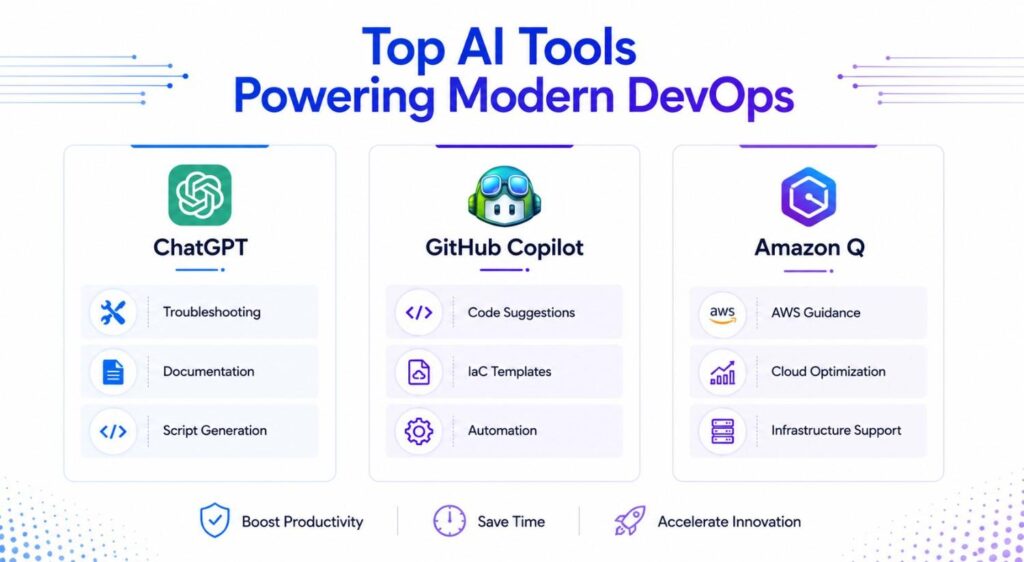
ChatGPT in DevOps
ChatGPT is one of the most widely used Artificial Intelligence (AI) tools today. While many people recognize it as a conversational AI assistant, its impact on modern DevOps workflows is far more significant.
From writing infrastructure code to troubleshooting deployment issues and generating technical documentation, ChatGPT for DevOps helps engineers save time, reduce manual effort, and improve productivity across the software development lifecycle.
How ChatGPT Helps DevOps Teams
Infrastructure Automation
Creating cloud infrastructure manually can be time-consuming. ChatGPT enables DevOps engineers to generate Infrastructure as Code (IaC) templates and automation scripts within seconds.
ChatGPT can generate:
- Terraform configurations
- Dockerfiles
- Kubernetes YAML files
- Ansible playbooks
This significantly reduces the time required to build, configure, and deploy infrastructure while improving consistency across environments.
Faster Troubleshooting
When applications fail or deployments encounter issues, engineers often spend hours analyzing logs and searching documentation. ChatGPT can quickly assist by identifying potential causes and recommending solutions.
ChatGPT can help:
- Explain error messages
- Suggest root causes
- Recommend troubleshooting steps
- Interpret complex logs
As a result, teams can reduce downtime, accelerate incident response, and restore services more efficiently.
CI/CD Pipeline Creation
Building deployment pipelines is another area where ChatGPT delivers significant value. It can generate pipeline configurations for popular DevOps platforms, helping teams implement automation faster.
Supported platforms include:
- Jenkins
- GitHub Actions
- GitLab CI/CD
- Azure DevOps
This enables organizations to standardize deployment workflows while reducing manual configuration effort.
Documentation Generation
Technical documentation is essential for successful DevOps operations, yet it is often overlooked due to limited time. ChatGPT simplifies documentation by automatically generating clear and structured content.
It can create:
- Runbooks
- Standard Operating Procedures (SOPs)
- Deployment guides
- Infrastructure documentation
Well-maintained documentation improves collaboration, accelerates onboarding, and helps teams share knowledge more effectively across projects.
GitHub Copilot: The AI Coding Assistant for DevOps
GitHub Copilot has become one of the most valuable AI-powered coding assistants for developers and DevOps engineers. Built to accelerate software development, it provides real-time code suggestions, automates repetitive coding tasks, and helps teams write cleaner, more efficient code.
Whether you’re creating automation scripts, managing cloud infrastructure, or building deployment pipelines, GitHub Copilot for DevOps can significantly improve productivity and reduce development time.
How GitHub Copilot Helps DevOps Engineers
Script Generation
Writing automation scripts is a core responsibility for DevOps professionals. GitHub Copilot can generate high-quality scripts in seconds, allowing engineers to focus on solving complex infrastructure challenges.
GitHub Copilot can generate:
- Bash scripts
- Python automation scripts
- PowerShell scripts
- Monitoring configurations
By automating repetitive coding tasks, teams can speed up development, reduce errors, and improve overall operational efficiency.
Infrastructure as Code (IaC) Assistance
Modern DevOps environments rely heavily on Infrastructure as Code (IaC) to manage cloud resources consistently. GitHub Copilot helps engineers create, optimize, and maintain infrastructure configurations with greater accuracy.
It supports popular Infrastructure as Code technologies, including:
- Terraform
- AWS CloudFormation
- Kubernetes
- Helm Charts
This enables faster infrastructure deployment while promoting consistency, scalability, and best practices across cloud environments.
Learning and Productivity
Whether you’re a beginner or an experienced DevOps professional, GitHub Copilot accelerates learning by suggesting code patterns, automation workflows, and industry best practices in real time.
As more organizations invest in AI-driven automation, understanding GitHub Copilot DevOps workflows is becoming an increasingly valuable skill for modern cloud and DevOps engineers.
Amazon Q: AI-Powered AWS Assistant for DevOps Engineers
Amazon Q is AWS’s generative AI assistant designed to help developers, Cloud Engineers, and DevOps professionals build, troubleshoot, and optimize applications running on Amazon Web Services (AWS).
Unlike general-purpose AI assistants, Amazon Q is deeply integrated with the AWS ecosystem. It provides intelligent recommendations, simplifies cloud management, and helps engineers resolve operational issues more efficiently.
Whether you’re deploying applications, configuring cloud infrastructure, or managing AWS services, Amazon Q for DevOps helps improve productivity while following AWS best practices.
Key Benefits of Amazon Q
Faster AWS Troubleshooting
One of Amazon Q’s biggest strengths is its ability to diagnose and resolve issues within AWS environments. It analyzes cloud resources, identifies potential problems, and recommends practical solutions to reduce downtime.
Amazon Q can assist with:
- Explaining AWS service errors
- Troubleshooting deployment failures
- Identifying configuration issues
- Analyzing logs and error messages
- Suggesting possible root causes and solutions
This enables DevOps teams to reduce troubleshooting time, improve incident response, and maintain highly available cloud environments.
AWS Guidance and Best Practices
Designing secure and scalable cloud infrastructure requires following AWS best practices. Amazon Q provides contextual recommendations that help engineers make informed decisions throughout the application lifecycle.
It offers guidance for:
- AWS architecture
- Security best practices
- Service selection
- Performance optimization
- Cloud resource configuration
These recommendations help organizations build reliable, secure, and cost-effective cloud solutions while aligning with AWS standards.
Developer Productivity
In addition to supporting DevOps teams, Amazon Q enhances developer productivity by simplifying common AWS tasks and providing instant technical assistance directly within development workflows.
Amazon Q can help developers:
- Understand AWS documentation
- Generate AWS CLI commands
- Create AWS CloudFormation templates
- Build AWS Lambda functions
- Answer AWS-related technical questions
By reducing the time spent searching documentation and troubleshooting cloud services, Amazon Q enables developers and DevOps engineers to focus on building scalable applications and accelerating software delivery.
AI Automation in DevOps
One of the most significant advancements in modern DevOps is the rise of AI Automation in DevOps. Unlike traditional automation, which follows predefined rules and workflows, AI-powered automation can analyze data, recognize patterns, learn from past events, and make intelligent recommendations.
By combining Artificial Intelligence (AI) with DevOps practices, organizations can improve operational efficiency, reduce manual intervention, and build more reliable software delivery pipelines.
Examples of AI Automation in DevOps
Intelligent Monitoring
AI-powered monitoring tools continuously analyze application performance and infrastructure health to detect issues before they impact users. This enables DevOps teams to respond proactively rather than reactively.
AI can help:
- Detect anomalies
- Identify unusual system behavior
- Predict potential failures
- Recommend corrective actions
This results in faster issue detection, reduced downtime, and improved application reliability.
Predictive Incident Management
Instead of waiting for systems to fail, AI analyzes historical data and real-time metrics to identify warning signs before outages occur. This proactive approach helps DevOps teams prevent incidents rather than simply responding to them.
With predictive insights, organizations can improve system availability, minimize business disruptions, and enhance customer experience.
Automated Security Analysis
Security is a critical component of modern DevOps workflows. AI-powered security tools continuously monitor cloud environments to identify risks and ensure compliance with industry standards.
AI can automatically detect:
- Security vulnerabilities
- Configuration errors
- Compliance issues
Continuous security analysis enables organizations to strengthen their cloud infrastructure while reducing the risk of cyber threats.
Cloud Cost Optimization
Managing cloud costs is a major challenge for many organizations. AI helps optimize cloud spending by analyzing resource utilization and identifying opportunities to reduce unnecessary expenses.
AI tools can identify:
- Idle resources
- Underutilized instances
- Oversized workloads
By optimizing cloud resources, organizations can lower infrastructure costs, improve operational efficiency, and maximize the value of their cloud investments.
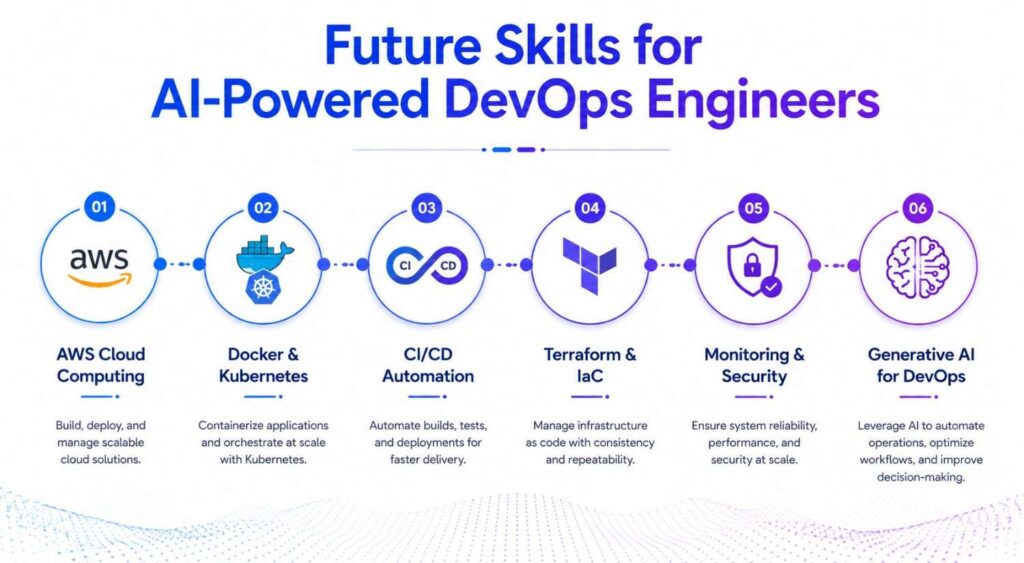
Future Skills Every DevOps Engineer Must Learn
As Artificial Intelligence (AI) becomes a standard part of modern DevOps workflows, professionals must develop a combination of cloud expertise, automation knowledge, and AI capabilities to remain competitive in the technology industry.
The future belongs to engineers who can effectively integrate AI tools into DevOps processes while maintaining strong technical fundamentals in cloud computing, infrastructure management, and software delivery.
1. Prompt Engineering
Knowing how to communicate effectively with AI tools is becoming an essential technical skill. Well-crafted prompts enable engineers to generate better code, automate repetitive tasks, troubleshoot issues faster, and improve overall productivity.
2. Cloud Computing
A strong understanding of cloud platforms remains one of the most valuable skills for every DevOps engineer. AI tools deliver the best results when combined with solid cloud architecture knowledge.
Leading cloud platforms include:
- Amazon Web Services (AWS)
- Microsoft Azure
- Google Cloud Platform (GCP)
Mastering these platforms enables engineers to design, deploy, and manage scalable cloud infrastructure efficiently.
3. Infrastructure as Code (IaC)
Infrastructure as Code (IaC) continues to be a core DevOps practice. Although AI can generate infrastructure configurations automatically, understanding the underlying concepts remains essential.
Popular IaC technologies include:
- Terraform
- AWS CloudFormation
- Ansible
These tools help organizations automate infrastructure provisioning while ensuring consistency across cloud environments.
4. CI/CD Automation
Continuous Integration and Continuous Deployment (CI/CD) are fundamental to modern software development. DevOps professionals should understand how to build automated deployment pipelines while leveraging AI to optimize workflows.
Common CI/CD platforms include:
- Jenkins
- GitHub Actions
- GitLab CI/CD
- Azure DevOps
Combining AI with CI/CD automation enables faster software releases, improved reliability, and reduced manual effort.
5. Containers and Kubernetes
Containerization remains the foundation of cloud-native application development. Every DevOps engineer should understand how containers simplify deployment, scalability, and application management.
Key container technologies include:
- Docker
- Kubernetes
- Helm
These technologies continue to power modern cloud infrastructure across startups and enterprise organizations worldwide.
6. AI Tool Integration
Future-ready DevOps professionals should become proficient with AI-powered development and automation tools that improve efficiency throughout the software lifecycle.
Essential AI tools include:
- ChatGPT
- GitHub Copilot
- Amazon Q
- AI-powered monitoring solutions
By combining these AI tools with modern DevOps practices, engineers can automate complex workflows, improve decision-making, and build a highly valuable skill set that employers increasingly seek in today’s cloud-driven technology landscape.
Why Companies Want AI + DevOps Engineers
Businesses today are under constant pressure to deliver software faster, reduce downtime, improve system reliability, and control operational costs. As digital transformation accelerates, organizations are seeking professionals who can combine Artificial Intelligence (AI) with DevOps to build smarter, more efficient development and operations workflows.
Engineers with expertise in both AI and DevOps can automate repetitive tasks, optimize cloud infrastructure, and improve software delivery. This combination of skills enables organizations to innovate faster while maintaining high performance, security, and scalability.
How AI + DevOps Engineers Add Business Value
Professionals with AI-powered DevOps skills help organizations by:
- Automating repetitive operational tasks
- Accelerating software deployments
- Reducing human errors through intelligent automation
- Improving incident detection and response
- Enhancing cloud infrastructure efficiency
- Optimizing cloud and infrastructure costs
These capabilities enable businesses to deliver high-quality applications more quickly while improving operational reliability and customer satisfaction.
Growing Demand for AI-Powered DevOps Professionals
As organizations continue investing in cloud computing, automation, and Generative AI, employers increasingly prefer candidates who can combine cloud expertise with AI-driven automation. Professionals who understand modern DevOps practices and AI technologies are becoming valuable assets across startups, enterprises, and global technology companies.
The future belongs to engineers who can successfully bridge the gap between traditional DevOps practices and emerging AI technologies. Developing these in-demand skills today can open the door to exciting career opportunities and long-term professional growth.
Kickstart Your DevOps Career with BinaryBrains
Ready to build expertise in AWS, DevOps, Cloud Computing, Kubernetes, and Generative AI? The AI Powered Masters Program in DevOps with AWS at BinaryBrains is designed to help students, fresh graduates, and working professionals gain practical, industry-ready skills through hands-on training, live projects, and expert mentorship.
Whether you’re starting your IT career or looking to upskill, our comprehensive training program prepares you for real-world DevOps roles with the latest cloud and AI technologies.
What You’ll Learn
- AWS & Cloud Computing
- Docker & Kubernetes
- CI/CD & DevOps Automation
- Terraform & Infrastructure as Code (IaC)
- Generative AI for DevOps
- Real-World Projects & Interview Preparation
Explore Our DevOps Programs
➡️ AI Powered Masters Program in DevOps with AWS
📞 Call / WhatsApp: +91 72497 56356
Take the first step toward a successful career in Cloud Computing, DevOps, and Artificial Intelligence with BinaryBrains today.
Comments are closed