

Introduction
Choosing the right technical course can be challenging, especially when several training institutes promise practical learning, industry-relevant skills and career support. If you want to develop your knowledge of cloud computing, automation and modern software delivery, selecting the right DevOps course is an important first step.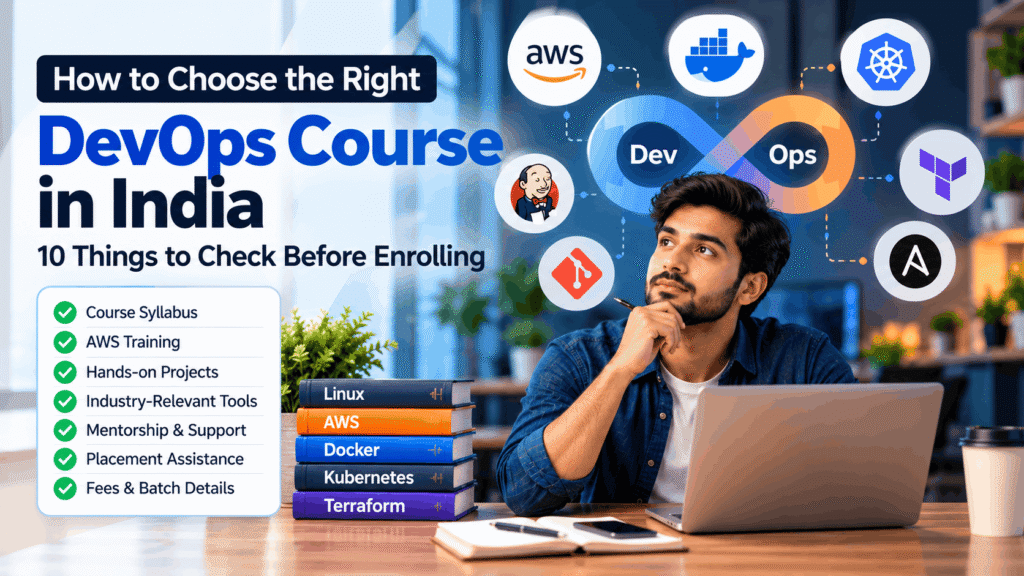
However, not every training program offers the same curriculum, practical exposure or learning experience. Some courses focus mainly on theory, whereas others introduce learners to cloud platforms, automation tools, deployment workflows and practical projects. Therefore, you should understand what a course actually offers before making a decision.
In this guide, we explain how to choose a DevOps course by evaluating the syllabus, AWS training, hands-on projects, modern tools, mentorship, course fees and placement assistance. We will also explore the AI-Powered Master Program in DevOps with AWS at BinaryBrains to help you understand what to look for before enrolling.
Whether you are a fresher, college student, working professional or someone planning a career transition, these points will help you compare your options more confidently.
Ready to explore DevOps training?
Why Is Choosing the Right DevOps Course Important?
DevOps combines software development and IT operations through practices such as automation, continuous integration, continuous delivery, infrastructure management, monitoring and collaboration.
Learning these practices requires more than memorising tool names. For example, understanding Docker becomes more useful when you know how containers fit into an application deployment workflow. Similarly, Kubernetes becomes easier to understand when you have a foundation in Linux, networking, containers and cloud infrastructure.
That is why a well-structured DevOps training course should introduce the fundamentals first and gradually move towards advanced technologies and practical implementation.
Before enrolling, compare the learning outcomes of different programs instead of selecting a course based only on its price, duration or promotional claims.
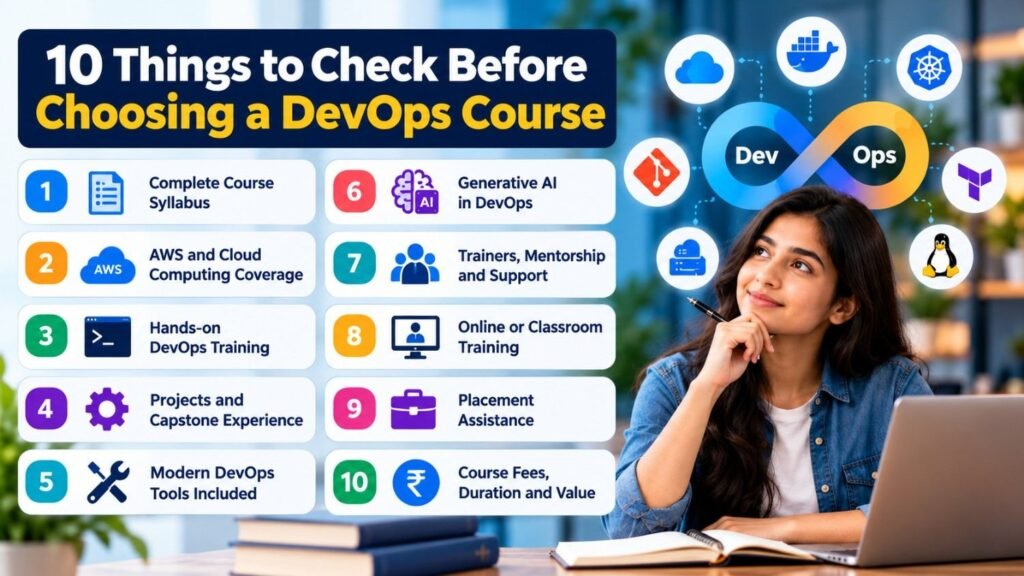
10 Things to Check Before Choosing a DevOps Course
Before choosing a training institute, evaluate the curriculum, practical experience, teaching support and overall value. The following ten points can help you make a more informed decision.
1. Review the Complete DevOps Course Syllabus
The syllabus should be your first checkpoint when comparing training institutes. A course that covers only a few popular tools may not provide enough context to understand a complete DevOps workflow.
Look for a structured DevOps course syllabus that progresses from foundational concepts to cloud computing, automation, deployment and monitoring.
Depending on the course level, a comprehensive curriculum may include:
- Python scripting and programming fundamentals
- Networking concepts and Linux administration
- AWS cloud services and infrastructure
- Git, GitHub and version control
- Continuous integration and continuous delivery (CI/CD)
- Jenkins and automation workflows
- Docker and Kubernetes
- Terraform and Ansible for infrastructure automation
- Monitoring, logging and observability
- Cloud security and DevSecOps concepts
- Generative AI tools and AI-assisted DevOps workflows
- Practical assignments and capstone projects
Nevertheless, the number of topics is not the only consideration. You should also check how much time the program allocates to practical implementation and whether the modules build upon one another.
Questions to ask before enrolling:
- Can I review the complete syllabus before making a payment?
- Are practical assignments included in the curriculum?
- Will I learn how the tools work together in a deployment workflow?
- Does the course explain the fundamentals before introducing advanced concepts?
Review the BinaryBrains DevOps with AWS program to explore its learning structure and technology coverage.
Want to understand the complete syllabus before deciding?
Book a Free Demo Class to discuss the course curriculum and learning options with the BinaryBrains team.
2. Check the AWS and Cloud Computing Coverage
Cloud infrastructure plays an important role in many modern DevOps workflows. Consequently, an AWS DevOps course should explain how applications are deployed, managed and monitored in cloud environments.
When reviewing the syllabus, look for relevant topics such as:
- Amazon EC2: Virtual computing and server management.
- Amazon S3: Object storage fundamentals.
- AWS IAM: Identity and access management.
- Amazon VPC: Cloud networking concepts.
- Load balancing and Auto Scaling: Application availability and scaling.
- Amazon CloudWatch: Monitoring and operational visibility.
- Amazon ECR, ECS and EKS: Container image management and container deployment workflows.
The exact depth of coverage varies by program. Therefore, check whether the course includes demonstrations and practical exercises rather than relying only on a list of AWS service names.
If cloud computing is one of your learning priorities, explore the AI-Powered Master Program in DevOps with AWS and discuss its AWS modules with the admissions team.
3. Look for Hands-On DevOps Training
Practical experience is one of the most important factors when selecting a DevOps course for beginners or experienced IT professionals.
Watching demonstrations can help you understand a concept. However, configuring a tool, troubleshooting an error and completing a deployment yourself can reveal where you need more practice.
Before enrolling, ask whether the course includes activities such as:
- Working with Linux commands and shell scripts
- Managing source code using Git and GitHub
- Building a CI/CD pipeline
- Creating and deploying Docker containers
- Deploying containerised applications
- Provisioning cloud infrastructure using Terraform
- Configuring monitoring and investigating application issues
Also, find out whether the institute provides guided lab sessions, assignment feedback and opportunities to repeat exercises.
For example, a practical assignment should help you understand not only how to execute a command but also why it is required, what can go wrong and how to troubleshoot the problem.
Before you enrol: Ask how practical sessions are delivered and whether you will have opportunities to complete exercises independently.
Book a Free Demo Class to discuss the course’s practical learning approach.
4. Evaluate the Projects and Capstone Experience
Projects allow you to combine individual concepts into a practical workflow. They can also help you explain your technical decisions when discussing your experience with a recruiter.
When comparing DevOps training courses, look for projects that require more than following a video tutorial. Ideally, you should understand the problem, implement a solution, test the workflow and explain the outcome.
Examples of useful DevOps learning projects include:
- Creating a CI/CD pipeline for an application
- Building and deploying a containerised application
- Provisioning AWS infrastructure using Infrastructure as Code
- Deploying an application on Kubernetes
- Setting up application and infrastructure monitoring
- Combining cloud infrastructure, automation and deployment in a capstone project
Ask the institute what you will build, which technologies you will use and how your work will be evaluated. The objective is to develop a clear understanding of the workflow rather than simply collect project titles.
The BinaryBrains program includes an enterprise capstone phase. You can review the program curriculum and capstone details before deciding whether its learning approach fits your goals.
5. Check the Modern DevOps Tools Included in the Course
The DevOps ecosystem includes many tools, and each one serves a different purpose. Therefore, a good DevOps course with AWS should explain how the technologies fit together instead of teaching them as unrelated topics.
Depending on the course level, you may encounter the following categories:
- Version control: Git and GitHub.
- CI/CD: Jenkins and pipeline automation.
- Containers: Docker.
- Container orchestration: Kubernetes.
- Infrastructure as Code: Terraform.
- Configuration management: Ansible.
- Monitoring and observability: Prometheus, Grafana and logging platforms.
- Cloud-native deployment: AWS container and infrastructure services.
- AI-assisted workflows: Tools such as ChatGPT, Claude, GitHub Copilot and Amazon Q Developer.
BinaryBrains describes its AI-Powered Master Program in DevOps with AWS as a 24-week learning journey covering more than 20 tools and technologies.
The program combines foundational learning, AWS, core and advanced DevOps, an enterprise capstone and career support.
Still, do not choose a course simply because it lists a large number of tools. Prioritise practical understanding, a logical curriculum and the relevance of each technology to your learning goals.
6. Understand How Generative AI Fits Into DevOps
Generative AI is becoming part of many software development and IT workflows. DevOps learners may use AI assistants to understand error messages, explore scripts, draft configurations, investigate troubleshooting options and improve technical documentation.
However, AI-generated commands and configuration files can contain mistakes or security risks. Learners must understand the underlying concepts and verify outputs before using them in real environments.
If AI integration matters to you, look for a DevOps course with Generative AI that teaches traditional DevOps fundamentals alongside responsible AI-assisted workflows.
For additional information, read the BinaryBrains article on DevOps training with GenAI and job assistance.
While comparing programs, ask how Generative AI is integrated into practical learning and whether the course explains the limitations of AI-generated technical outputs.
7. Evaluate Trainers, Mentorship and Doubt-Solving Support
Technical training often involves unexpected errors, unfamiliar terminology and problems that require several attempts to solve. Access to guidance can help you work through these challenges more effectively.
Before enrolling, ask about the trainers’ relevant experience, the format of live sessions, the availability of doubt-clearing sessions and the feedback provided on assignments.
You should also check whether the institute provides learning resources, session recordings or a learning management system, particularly if you have college or work commitments.
Consider asking the following questions:
- How can students ask technical questions outside class?
- Are practical assignments reviewed by trainers?
- What happens if I miss a live session?
- Is guidance available when I get stuck on a project?
- Are additional learning resources provided?
A transparent answer to these questions can help you understand what support you will receive after joining the course.
Have questions about the training format or syllabus?
Talk to the BinaryBrains team or call +91-72497 56356 to discuss your requirements.
8. Compare Online and Classroom DevOps Training
The right learning format depends on your schedule, location and personal preferences. Some learners prefer face-to-face interaction, while working professionals may need the flexibility of online sessions.
When comparing an online DevOps course with classroom training, consider:
- Whether classes are live, recorded or a combination of both
- How practical labs and assignments are delivered
- Whether trainers are available to answer questions
- Whether missed sessions can be reviewed later
- How much time you should allocate each week
- Whether the batch schedule fits your existing commitments
BinaryBrains offers live online and classroom learning options for its AI-Powered Master Program in DevOps with AWS. Confirm the current schedule, location and availability with the admissions team before making your decision.
If you are specifically looking for local training, explore the DevOps training program in Pune for location-specific information.
Not sure which learning format suits you?
Book a Free Demo Class to discuss the available options before enrolling.
9. Understand Placement Assistance Before Enrolling
Career support is another important factor when evaluating a DevOps course with placement assistance. However, it is essential to understand exactly what the institute provides.
Before enrolling, ask whether the program includes support such as:
- Resume preparation and profile improvement
- Technical interview preparation
- Mock interviews and feedback
- Guidance on presenting projects and technical skills
- Career mentoring and job-search preparation
- Referrals or access to relevant opportunities, where available
You should also ask about eligibility requirements, the process for accessing support and any conditions that apply.
Important: Placement assistance is not the same as a guaranteed job. Your results will depend on factors such as your technical skills, practical experience, interview performance, eligibility and available opportunities.
Before joining, review the program details and discuss the scope of career support directly with the BinaryBrains admissions team.
10. Compare Course Fees, Duration and Overall Value
Course fees matter, but the lowest-priced option is not necessarily the best fit for your goals. Instead, compare the complete learning experience and the services included in the fee.
Before paying, check the following details:
- The total course fee and applicable taxes
- Payment plans and instalment options, if available
- Course duration and weekly time commitment
- Access to practical labs and learning resources
- Whether projects and capstone work are included
- Trainer support and mentorship arrangements
- Course access duration and any additional charges
- The exact terms of internship and placement assistance
A structured program may offer better value when its curriculum, practical sessions, support and learning resources align with your needs.
Since fees and batch availability can change, request the latest details directly from the institute instead of relying on outdated online information.
You can use the BinaryBrains course enquiry page to ask about fees, upcoming batches and available learning options.
Want to know the current fees and batch schedule?
Which DevOps Course Is Suitable for Your Background?
Your existing knowledge and career goals should influence your course selection. Consider the following examples when shortlisting programs.
DevOps Courses for College Students and Freshers
If you are a student or recent graduate, prioritise a course that explains the fundamentals before moving into advanced automation and cloud infrastructure.
Python, networking and Linux can provide a useful foundation for later modules. Look for guided practical exercises and projects that help you explain what you have learned.
Also, check the admission requirements and whether the course expects previous programming or cloud experience.
DevOps Training for Working IT Professionals
If you already work in software development, system administration, IT support or cloud operations, compare the syllabus with your current skills.
You may benefit from deeper coverage of CI/CD, AWS, containers, infrastructure automation, monitoring and deployment workflows. Additionally, check the timetable and weekly study commitment before joining.
DevOps Courses for Career Changers
If you are moving into a technical role from another field or returning after a career break, look for a structured program that explains prerequisites and provides enough time to practise.
Ask how foundational topics are taught, what learning resources are provided and how much additional effort may be needed outside scheduled sessions.
Why Consider BinaryBrains for DevOps with AWS and GenAI?
After comparing the curriculum, practical learning and career support, the next step is to review the program that best matches your requirements.
The AI-Powered Master Program in DevOps with AWS at BinaryBrains brings cloud computing, DevOps automation and Generative AI into a structured learning journey.
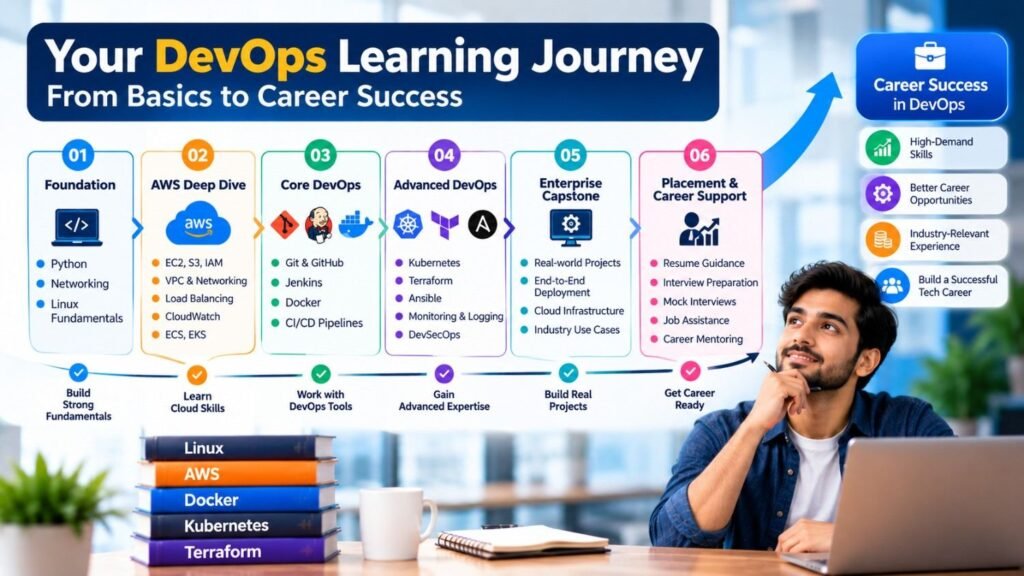
According to the program details, the course spans 24 weeks and covers more than 20 tools and technologies. Its six learning phases are:
- Foundation: Python, networking and Linux fundamentals.
- AWS Deep Dive: Cloud services and infrastructure concepts.
- Core DevOps: Version control, CI/CD, containers and automation.
- Advanced DevOps: Advanced cloud-native and operational technologies.
- Enterprise Capstone: Applying learned skills through a larger practical project.
- Placement and Career Support: Career preparation and placement-focused guidance.
The curriculum also covers technologies and workflows related to Docker, Kubernetes, Terraform, Ansible, monitoring, DevSecOps and Generative AI.
Before enrolling, review the complete curriculum, confirm the current batch schedule and ask questions about projects, learning support, fees and career assistance.
To explore the available learning options, visit the DevOps courses and certification programs at BinaryBrains.
Take the Next Step with BinaryBrains
If you are comparing DevOps courses, speak with the team before making your final decision. Discuss the curriculum, practical training, course fees and learning format to understand whether the program matches your goals.
Book a Free Demo Class
Understand the curriculum and discuss whether the course matches your goals.
Call or WhatsApp BinaryBrains
Ask about course fees, upcoming batches and online or classroom training.
Enquire About the Course
Submit your details to discuss the syllabus, fees and learning options.
Checklist: Before You Enrol in a DevOps Course
Use this checklist when speaking with a training institute:
- Have I reviewed the complete syllabus?
- Does the curriculum cover Linux, networking, AWS and automation?
- Are hands-on labs and practical projects included?
- Will I learn how the tools work together in a deployment workflow?
- Are trainers and doubt-solving support available?
- Does the learning format suit my schedule?
- Are the fees, payment terms and additional costs clear?
- Have I understood the placement assistance policy?
- Have I checked the duration, prerequisites and expected study time?
- Have I spoken with the admissions team before making a decision?
Taking time to review these points can help you compare courses objectively and select a learning path that fits your current skills and future goals.
Frequently Asked Questions
Frequently Asked Questions
1. Explore More DevOps Blogs and Resources
2. Can a beginner enrol in a DevOps course?
3. What should a good DevOps course syllabus include?
4. Is AWS necessary for learning DevOps?
5. How long does it take to complete a DevOps course?
6. Does a DevOps course guarantee placement?
7. How can I enquire about the BinaryBrains DevOps program?
Explore More DevOps Blogs and Resources
Choosing the right DevOps course is an important first step toward building your technical skills. To explore the field further, read these related guides from BinaryBrains. They cover DevOps career planning, AWS training, Generative AI and learning opportunities.
- AI DevOps Engineer Roadmap 2026 — Explore the skills, technologies and learning steps involved in building a career in AI-powered DevOps.
- DevOps Course with GenAI and Job Assistance — Learn about DevOps training that incorporates Generative AI and career support.
- AI-Powered Master Program in DevOps with AWS — Explore the course structure, cloud technologies, practical learning and career support.
- DevOps with AWS Training in Pune — Review the Pune-focused training option and its program details.
- AWS Training and Certification — Explore AWS learning and certification training options.
- AWS DevOps Engineer Salary in Pune: Skills, Jobs and Career Roadmap — Understand the career factors, skills and opportunities associated with AWS DevOps roles.
For more learning resources, visit the BinaryBrains blog.
Ready to Start Your DevOps Learning Journey?
Now that you know what to check before enrolling, take time to compare the syllabus, practical training, course duration and career support. If you are looking for structured training in DevOps, AWS and Generative AI, explore the BinaryBrains program and discuss whether it matches your career goals.
Explore the DevOps with AWS Program
Have questions about course fees, upcoming batches or training options?
Comments are closed