

Introduction
Modern software teams need to release features quickly without sacrificing reliability, code quality or security. A DevOps testing pipeline helps teams automate validation throughout the software delivery lifecycle—from source code and builds to security scans, container deployment and monitoring.
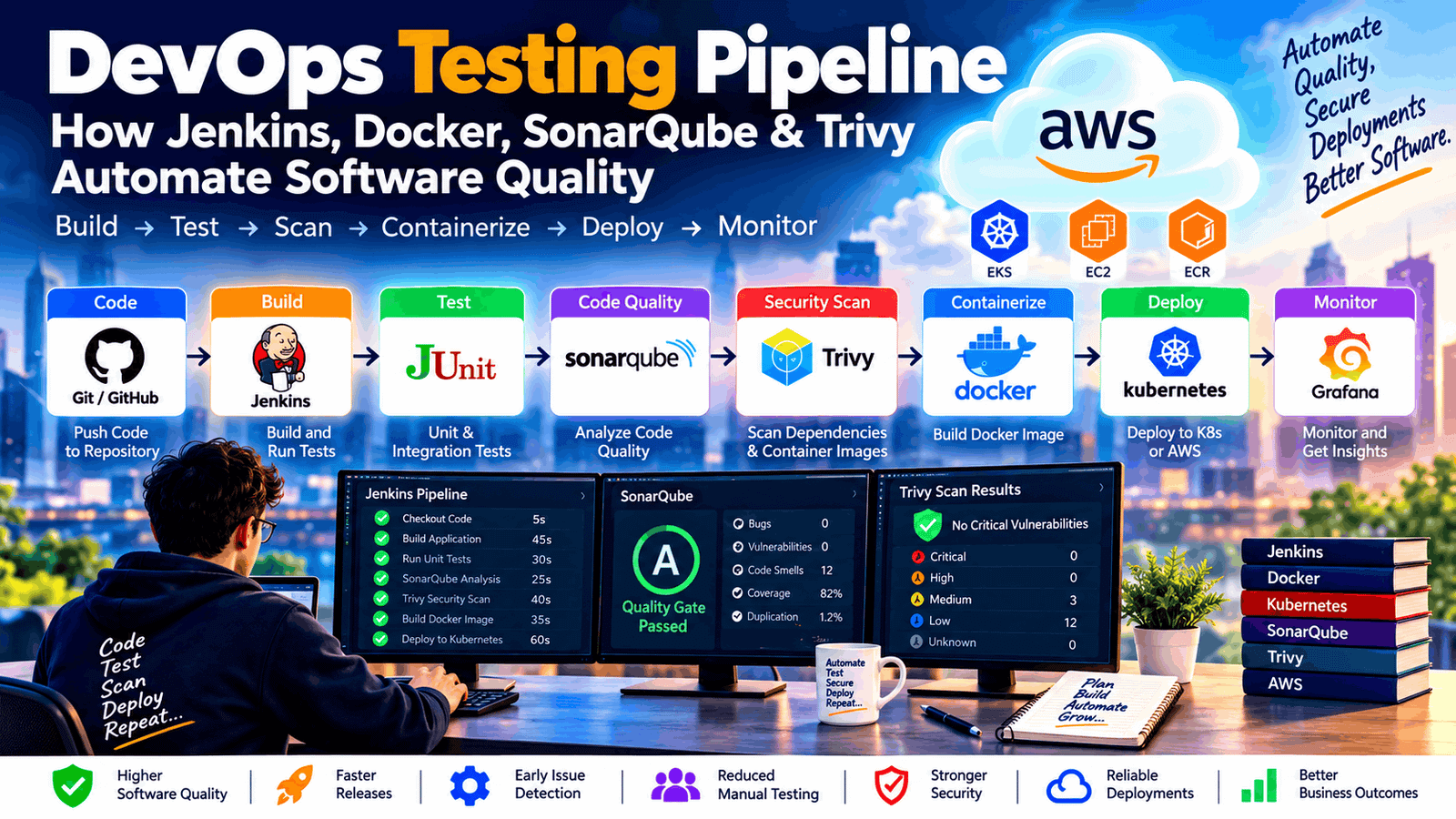
Tools such as Git, Jenkins, Maven, SonarQube, Trivy, Docker, Kubernetes and AWS can work together to create a repeatable CI/CD workflow. In this guide, we explain what each tool contributes, how the stages connect, common mistakes to avoid and which skills to learn next.
What Is a DevOps Testing Pipeline?
A DevOps testing pipeline is an automated sequence of testing and validation stages integrated into a continuous integration and continuous delivery (CI/CD) pipeline. When a developer pushes code to a repository, the pipeline can build the application, run tests, analyse code quality, scan for vulnerabilities and validate the release before deployment.
The exact stages depend on the application architecture, technology stack and organisational requirements. Common checks include:
- Code compilation and build validation
- Unit and integration testing
- Functional or end-to-end testing
- Automated code-quality analysis
- Dependency and container-image security scanning
- Container and deployment validation
- Infrastructure checks and post-deployment monitoring
For a beginner-friendly introduction, read our guide to the Best DevOps Course for Beginners.
Why Is Automated Testing Important in DevOps?
DevOps is not simply about deploying software faster. The objective is to create a dependable process for developing, testing, releasing and operating applications. Without validation, automation can move defects into production just as efficiently as it moves successful changes.
Earlier defect detection
Automated checks can identify issues closer to the time a change is introduced, helping developers investigate sooner.
Faster feedback
Pipeline results give teams a consistent signal about whether a build has passed its required checks.
Repeatable releases
Defined stages reduce reliance on ad-hoc manual steps and make release processes more consistent.
Improved security visibility
Security scans can be included before images and applications progress toward deployment.
This connects with Shift-Left Testing, which introduces appropriate quality and security checks earlier in the development lifecycle. You can also explore our guide to DevOps Training in Pune with AWS for more context on CI/CD and cloud workflows.
Where Does Testing Fit into a CI/CD Pipeline?
Testing is not necessarily one isolated stage. Different checks can run at different points in the delivery lifecycle, depending on what is being validated.
- Source code: Developers commit and push changes to Git or GitHub.
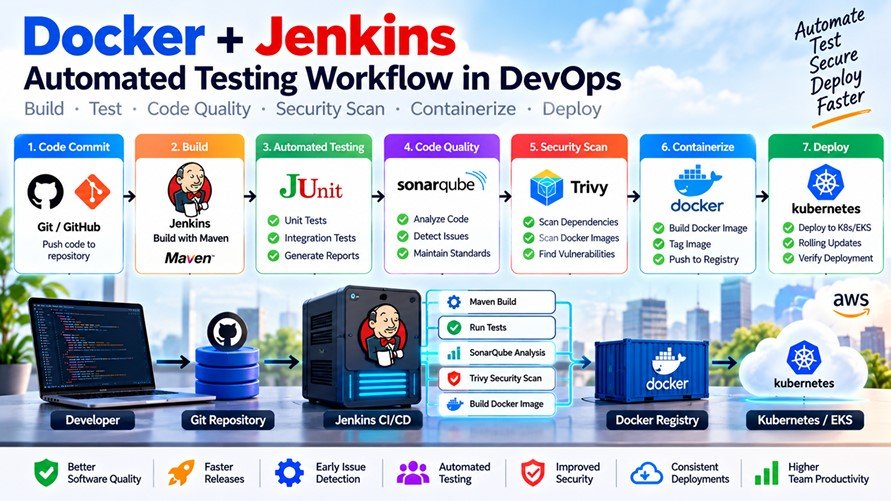
- Build: Jenkins retrieves the code and starts the build; Maven can manage the build lifecycle for Java applications.
- Unit tests: Individual functions or components are tested.
- Integration tests: Connected components, APIs, databases or services are tested together.
- Code quality: SonarQube analyses source code against configured rules.
- Security scan: Trivy can scan supported artefacts, including container images, for known vulnerabilities.
- Containerization: Docker packages the application and its dependencies into an image.
- Deployment: The validated image can be deployed to Kubernetes or an appropriate AWS container service.
- Monitoring: Tools such as Prometheus, Grafana and Amazon CloudWatch help teams observe application and infrastructure behaviour.
How Jenkins Automates Testing
Jenkins is an automation server commonly used to orchestrate CI/CD workflows. A pipeline can trigger after a repository change and run build, testing, quality, security and deployment stages in a defined order.
Jenkins can use a Jenkinsfile to define pipeline stages as code. Teams can configure conditions so a failed test, a quality-gate result or a security policy blocks later stages. This is often described as a quality gate or pipeline control.
Explore the DevOps Course with Gen AI and Job Assistance to learn more about Jenkins, declarative pipelines, agents, plugins, notifications and AI-assisted pipeline troubleshooting.
Maven and Automated Application Testing
For Java projects, Maven supports dependency management and a standardised build lifecycle. It can be integrated with Jenkins so code changes trigger repeatable builds and tests.
Maven can manage project dependencies, plugins, build configuration, test execution and artifact creation. The exact build and test commands depend on the project configuration.
SonarQube for Code Quality
Functional tests help verify that an application behaves as expected, but code quality involves additional considerations. SonarQube analyses source code and can identify issues that require attention before a change progresses through the delivery process.
Depending on the language, edition and configured rules, teams can use SonarQube to review code issues, maintainability concerns, technical debt and quality-gate results. It complements functional testing; it does not replace it.
Trivy for DevSecOps Security Scanning
Trivy is a security scanner that can identify known vulnerabilities in supported artefacts, including container images. It can be added to a pipeline so teams receive security findings before an image proceeds toward deployment.
Teams can configure their own severity thresholds and failure conditions. For example, a pipeline may be configured to stop when findings meet a defined criticality threshold. Security policies should be documented and reviewed instead of bypassed simply to make a build pass.
This is part of DevSecOps: integrating security into development and delivery rather than treating it as a final, separate activity.
Docker Testing in a DevOps Pipeline
Docker packages an application and its dependencies into a container image. Once earlier checks pass, a pipeline can build the image, scan it, publish it to a container registry and promote it through environments.
Using a consistent image across environments can improve repeatability. However, environment-specific configuration, secrets, permissions and runtime behaviour still need appropriate validation.
Kubernetes Testing and Deployment Validation
After containerization, an application may be deployed to Kubernetes. Validation can include checking deployment status, pod health, service communication, configuration, secrets, resource settings, scaling behaviour and application connectivity.
On AWS, Amazon EKS provides managed Kubernetes capabilities. Deployment strategies and rollback procedures can help teams manage releases, but they should be tested against the needs of the application.
For a broader learning path covering Kubernetes, AWS and Infrastructure as Code, read the AI DevOps Engineer Roadmap 2026.
Unit Testing vs Integration Testing vs Security Testing
| Testing type | Main purpose | Example |
|---|---|---|
| Unit testing | Tests individual components in isolation. | Validate a function or class. |
| Integration testing | Checks whether connected components work together. | Verify API-to-database communication. |
| Functional testing | Checks application behaviour against requirements. | Validate a user workflow. |
| Security testing | Looks for security weaknesses or known vulnerabilities. | Scan a container image with Trivy. |
| End-to-end testing | Validates a complete application workflow. | Test a process across multiple services. |
A mature testing strategy combines appropriate layers. Each layer provides a different kind of evidence; one test type cannot replace all the others.
Automated Testing with AWS DevOps
AWS provides infrastructure and services that can support CI/CD workflows. Depending on the architecture, teams may use EC2, S3, VPC, ECR, ECS, EKS, Fargate, Elastic Load Balancing and CloudWatch.
Amazon ECR can store container images, while Amazon EKS can run Kubernetes workloads. The actual design depends on application needs, security requirements, costs and operational capabilities.
To build your cloud foundation, explore AWS Training and Certification or our AWS Solutions Architect Certification Training.
Terraform and Infrastructure as Code
Application testing is only one part of a reliable delivery process. The infrastructure where the application runs also needs to be managed consistently. Infrastructure as Code (IaC) lets teams define infrastructure through configuration files rather than relying exclusively on manual setup.
Infrastructure changes should also be reviewed and validated. Teams should protect credentials, review planned changes and use appropriate access controls before applying infrastructure updates.
Monitoring After Testing and Deployment
A successful deployment does not guarantee that an application will remain healthy. Monitoring and observability help teams understand application behaviour, infrastructure performance, error rates, resource use, logs and alerts after release.
- Prometheus: metrics collection and monitoring workflows.
- Grafana: dashboards and visualisation.
- ELK: log collection, search and analysis workflows.
- Datadog: observability across supported systems.
- Amazon CloudWatch: monitoring and observability for AWS resources and applications.
For role-based context, see DevOps Engineer Roles and Responsibilities.
How Generative AI Can Assist DevOps Testing
Generative AI tools can assist engineers with generating test ideas, explaining errors, drafting scripts, reviewing configuration, analysing logs, documenting pipelines and suggesting troubleshooting steps. Tools such as ChatGPT, Claude, GitHub Copilot and Amazon Q Developer may support different tasks in the DevOps lifecycle.
However, AI-generated code, commands and infrastructure configurations must be reviewed and tested before use. They can contain errors, insecure recommendations or assumptions that do not match the target environment.
Read How Generative AI Is Transforming DevOps for more examples of AI-assisted workflows.
Common DevOps Testing Pipeline Mistakes
- Testing only at the end: introduce appropriate checks earlier to provide faster feedback.
- Ignoring integration tests: individually working components can still fail when they communicate.
- Skipping security scanning: code-quality analysis alone does not replace vulnerability scanning.
- Ignoring failed tests: investigate failures and avoid bypassing quality gates without a documented reason.
- Using too many tools without a clear workflow: understand how each tool contributes to the delivery process.
- Not monitoring production: continue observing the application after deployment.
- Trusting AI output without review: validate generated code, commands and configuration before production use.
Example of a Complete DevOps Testing Pipeline
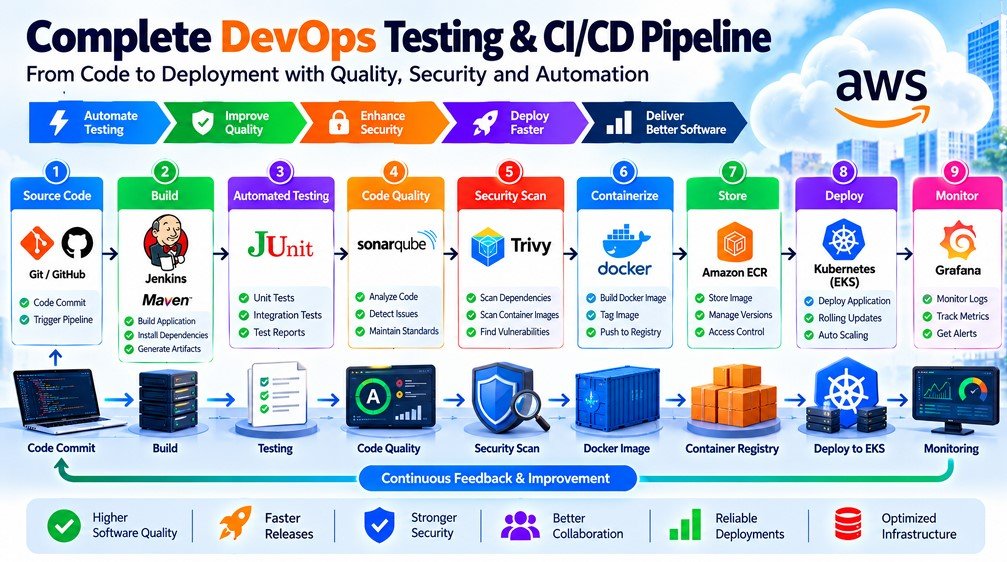
Consider a cloud-native application deployed to AWS. A simplified end-to-end workflow could look like this:
- A developer pushes source code to GitHub.
- Jenkins starts the pipeline.
- Maven builds the Java application.
- Unit and integration tests run.
- SonarQube analyses source-code quality.
- Docker builds the container image.
- Trivy scans the image for vulnerabilities.
- The approved image is pushed to Amazon ECR.
- The image is deployed to Amazon EKS.
- Prometheus, Grafana and other monitoring tools help observe the application.
The exact sequence may vary. For example, teams can scan dependencies earlier, run different tests in parallel or use another deployment target based on their architecture and release controls.
DevOps Testing Skills You Should Learn
- Foundation: Linux, networking, Python and Git.
- CI/CD: Jenkins, GitHub Actions, Maven and pipeline fundamentals.
- Testing: unit, integration, API and automated testing.
- Code quality and security: SonarQube, quality gates, Trivy and DevSecOps.
- Containers and orchestration: Docker, Docker Compose, Kubernetes, Helm and container registries.
- Infrastructure: Terraform and Ansible.
- Cloud: AWS, ECR, ECS, EKS and Fargate.
- Monitoring: Prometheus, Grafana, ELK, Datadog and CloudWatch.
- AI assistance: ChatGPT, Claude, GitHub Copilot and Amazon Q Developer.
Learning these tools in a connected workflow is more useful than memorising names in isolation. Start with the fundamentals and build practical projects as your knowledge develops.
Learn Practical DevOps with BinaryBrains
Understanding how Jenkins, Maven, SonarQube, Trivy, Docker, Kubernetes, Terraform and AWS work together is an important step toward building practical CI/CD skills. Hands-on labs and end-to-end projects can help connect individual tools into a complete delivery workflow.
Build Your AWS, DevOps & CI/CD Skills
Explore a structured learning path covering cloud foundations, CI/CD, containers, Kubernetes, Infrastructure as Code, DevSecOps, monitoring and Generative AI.
Frequently Asked Questions
1. What is a DevOps testing pipeline?
A DevOps testing pipeline is an automated workflow that integrates testing, code-quality validation, security scanning and deployment checks into the CI/CD process.
2. Which tools are used in a DevOps testing pipeline?
Common tools include Git, Jenkins, Maven, SonarQube, Trivy, Docker, Kubernetes and AWS services. The exact toolchain depends on the project and its requirements.
3. What is SonarQube used for?
SonarQube analyses source code for code-quality issues and can provide quality-gate results based on configured rules.
4. What is Jenkins used for in DevOps testing?
Jenkins can automate builds, execute tests, run quality and security checks, and control later pipeline stages based on configured results.
5. What is Trivy used for in a CI/CD pipeline?
Trivy scans supported artefacts, including container images, for known vulnerabilities. Teams can use its results within defined security policies.
6. Why is integration testing important?
Integration testing checks whether application components—such as APIs, backend services and databases—communicate and work together correctly.
7. How does Docker support DevOps testing?
Docker packages an application and its dependencies into a container image, helping provide consistent environments for testing and deployment.
8. What is DevSecOps?
DevSecOps integrates security practices into software development and delivery so security checks can be performed throughout the lifecycle.
9. Can Generative AI help with DevOps testing?
AI can assist with test ideas, scripts, error explanations, log analysis and troubleshooting. Engineers should review and validate AI-generated output before production use.
10. How can I learn DevOps testing practically?
Start with Linux, networking, Python and Git, then learn CI/CD, Jenkins, Maven, Docker, Kubernetes, SonarQube, Trivy, AWS, Terraform and monitoring. Build projects that connect these technologies.
Keep learning, keep testing and make quality part of every release.
Comments are closed