

AWS Solutions Architect Course: Build Real-World Cloud Skills
Cloud computing has become an essential part of modern IT infrastructure. As more businesses move applications, databases, networking, and workloads to the cloud, professionals with practical AWS cloud skills are increasingly valuable.
AWS provides a broad ecosystem of services for computing, storage, networking, databases, security, monitoring, automation, and application development. However, learning AWS effectively requires more than simply understanding individual services.
An AWS Solutions Architect Course can help learners understand how different AWS services work together to build scalable, secure, resilient, and cost-effective cloud solutions.
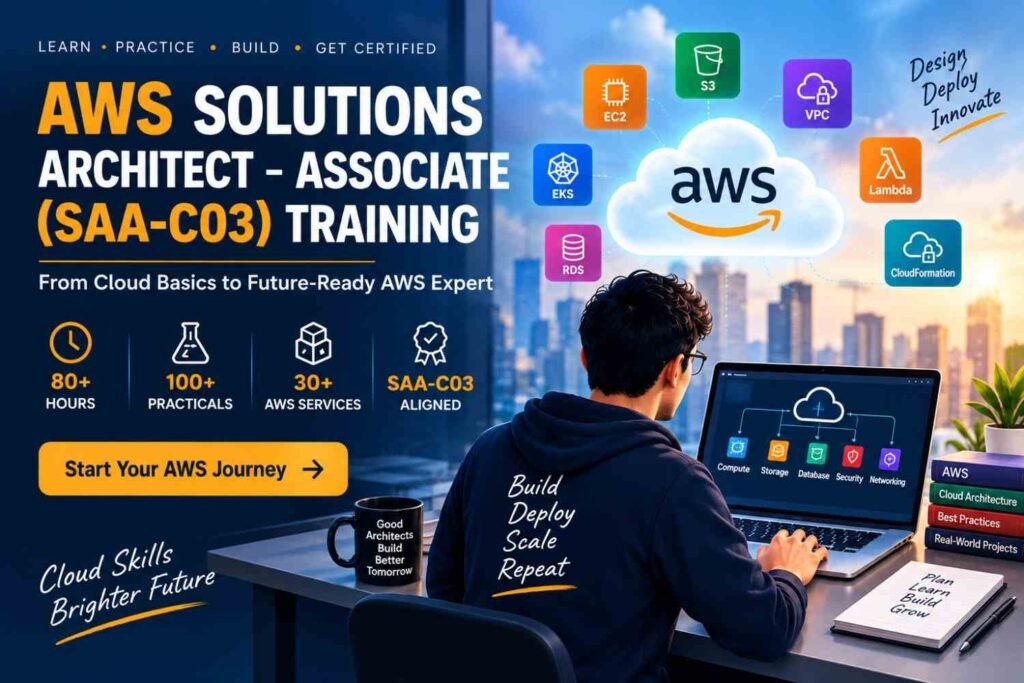
BinaryBrains offers an AWS Certified Solutions Architect – Associate (SAA-C03) training program designed around practical learning, AWS labs, real-world projects, and certification preparation.
This guide will help you understand:
- What an AWS Solutions Architect does
- What you learn in an AWS Solutions Architect course
- The AWS SAA-C03 curriculum
- Important AWS services and technologies
- Hands-on AWS projects
- Certification preparation
- Who can join AWS training
- Career opportunities after learning AWS
What Is an AWS Solutions Architect?
An AWS Solutions Architect designs cloud solutions using AWS services according to business, technical, security, scalability, and cost requirements.
The role involves understanding how different AWS services can be combined to create reliable and efficient cloud architectures.
An AWS Solutions Architect may work with services such as Amazon EC2, Amazon S3, Amazon VPC, IAM, Amazon RDS, AWS Lambda, Amazon CloudFront, Route 53, and CloudWatch.
The goal is not simply to deploy individual services. Instead, architects need to understand how these services work together to create complete cloud environments.
For example, a highly available web application may combine EC2, Auto Scaling, an Application Load Balancer, and Multi-AZ RDS to improve availability and resilience.
Why Learn AWS?
AWS skills can be useful for professionals working in cloud computing, infrastructure, software development, DevOps, networking, security, and IT support.
The BinaryBrains course brochure highlights the growing importance of cloud professionals and focuses on AWS as a platform for building practical cloud skills.
Learning AWS can help you develop knowledge in:
- Cloud infrastructure
- Compute services
- Storage
- Networking
- Databases
- Identity and access management
- Security
- Monitoring
- Automation
- High availability
- Disaster recovery
- Cost optimization
More importantly, practical AWS training can help learners understand how these areas come together when designing real cloud solutions.
AWS Solutions Architect Course Overview
The BinaryBrains AWS Certified Solutions Architect – Associate (SAA-C03) program is structured as a hands-on training journey from cloud fundamentals to architecture design and certification preparation.
The program includes:
- 80+ hours of training
- 100+ practical AWS labs
- 30+ AWS services
- SAA-C03 aligned curriculum
- Hands-on AWS account practice
- Real-world projects and case studies
- Domain-wise practice sets
- 3 full-length mock exams
- Exam-focused preparation
- Career and placement support
The brochure describes the curriculum as expert-designed and aligned with the AWS Certified Solutions Architect – Associate SAA-C03 exam guide.
Who Can Join an AWS Solutions Architect Course?
AWS training can be useful for learners from different technical backgrounds. The BinaryBrains program is designed for both existing IT professionals and beginners interested in cloud computing.
IT Professionals
Developers, testers, and support professionals can use AWS training to expand their knowledge into cloud-based roles.
System and Network Administrators
Professionals with infrastructure experience can apply their existing networking and system knowledge to AWS cloud environments.
IT Support Professionals
IT support professionals can build cloud skills while developing their understanding of AWS infrastructure and services.
DevOps and Automation Enthusiasts
AWS provides an important foundation for professionals interested in DevOps, CI/CD, cloud automation, and infrastructure management.
Freshers and Career Switchers
The brochure states that the program starts with foundational concepts and does not require mandatory prior coding experience.
Entrepreneurs and Freelancers
AWS knowledge can also help entrepreneurs and freelancers understand how to build, deploy, and scale applications using cloud services.
What Will You Learn in an AWS Solutions Architect Course?
The curriculum covers AWS fundamentals as well as architecture, networking, security, storage, databases, monitoring, automation, disaster recovery, and cost management.
The major learning areas include:
- Cloud fundamentals and AWS global infrastructure
- Identity and Access Management
- Amazon EC2 and compute services
- Amazon VPC and networking
- Amazon S3 and storage
- Amazon RDS and databases
- Monitoring and management
- Security and compliance
- High availability and fault tolerance
- Cost optimization
- Deployment and automation
- AWS Well-Architected Framework
- Real-world projects and case studies
1. Cloud and AWS Foundations
A strong AWS learning journey begins with understanding cloud computing fundamentals and AWS infrastructure.
Key Topics
- Cloud computing concepts
- IaaS, PaaS, and SaaS
- Public, private, and hybrid cloud deployment
- AWS global infrastructure
- Availability and scalability concepts
These fundamentals provide the foundation required to understand more advanced AWS architecture concepts.
2. Identity and Access Management with AWS IAM
AWS Identity and Access Management (IAM) controls access to AWS resources and is an important part of secure cloud architecture.
The course curriculum covers:
- IAM users, groups, roles, and policies
- Policy evaluation logic
- Least-privilege access
- IAM roles and cross-account access
- MFA
- Access keys and rotation
- AWS Organizations and Service Control Policies
- IAM Identity Center
- STS and federation
Understanding IAM helps learners design AWS environments with appropriate access controls and security practices.
3. Amazon VPC and AWS Networking
Amazon VPC provides networking capabilities for AWS resources. Understanding VPC architecture is essential for designing secure and reliable cloud environments.
Topics Covered
- VPCs and subnets
- Route tables
- Internet gateways
- NAT gateways
- Security groups
- Network ACLs
- VPC peering
- Transit Gateway
- VPC endpoints
- PrivateLink
- Direct Connect
- VPN
- Route 53
The curriculum also covers the difference between Security Groups and Network ACLs, which is important when designing AWS network security.
4. AWS Compute: EC2, Auto Scaling and Load Balancing
Compute services provide the processing capacity required to run applications in the cloud.
The AWS Solutions Architect curriculum covers Amazon EC2 along with scaling and load-balancing concepts.
Topics Include
- EC2 instances
- Amazon Machine Images
- Instance metadata
- On-Demand instances
- Reserved Instances
- Spot Instances
- Savings Plans
- EBS volumes
- Snapshots
- Application Load Balancer
- Network Load Balancer
- Gateway Load Balancer
- EC2 Auto Scaling
- Launch templates
- Lambda
- ECS
- EKS
- Fargate
5. AWS Storage Services
AWS provides multiple storage services for different application and data requirements.
The course covers important storage technologies including:
- Amazon S3
- S3 storage classes
- S3 lifecycle management
- S3 versioning
- S3 replication
- S3 security
- Presigned URLs
- Amazon EBS
- Amazon EFS
- Amazon FSx
- Storage Gateway
- AWS Backup
- DataSync
- Snow Family
These concepts help learners understand how to select appropriate AWS storage solutions for different workloads.
6. AWS Database Services
AWS provides managed database services for relational, NoSQL, caching, analytics, and specialized workloads.
The curriculum covers:
- Amazon RDS
- Multi-AZ deployments
- Read replicas
- Amazon Aurora
- Aurora Serverless
- Amazon DynamoDB
- Global Secondary Indexes
- Local Secondary Indexes
- DAX
- ElastiCache
- Redis and Memcached
- Amazon Redshift
- Amazon Neptune
- Database Migration Service
Understanding database selection is an important part of designing scalable and reliable AWS architectures.
7. Monitoring, Automation and Infrastructure as Code
Cloud environments require continuous monitoring and automation to maintain visibility, reliability, and operational efficiency.
Monitoring
- Amazon CloudWatch
- Metrics
- Alarms
- Logs
- AWS CloudTrail
- AWS Config
- AWS X-Ray
Automation
- AWS Systems Manager
- Parameter Store
- AWS CloudFormation
- Trusted Advisor
- AWS Health Dashboard
AWS CloudFormation introduces Infrastructure as Code concepts, allowing AWS infrastructure to be defined and managed through templates.
8. Application Integration and Decoupling
Modern applications often use multiple services that need to communicate reliably. AWS provides several services for application integration and event-driven architectures. The course covers:- Amazon SQS
- Standard and FIFO queues
- Amazon SNS
- Fan-out patterns
- Amazon EventBridge
- AWS Step Functions
- Amazon API Gateway
- Amazon Kinesis
- Streams and Firehose
9. AWS Security, Encryption and Compliance
Security is an important part of AWS architecture. The course covers multiple AWS security services and encryption concepts.
Security Topics
- AWS KMS
- Envelope encryption
- CloudHSM
- ACM certificates
- AWS Secrets Manager
- Parameter Store
- AWS WAF
- AWS Shield
- Firewall Manager
- GuardDuty
- Inspector
- Macie
- Security Hub
- Network Firewall
- Compliance concepts
These topics help learners understand how security can be incorporated into AWS cloud architecture.
10. Edge Computing, CDN and Global Applications
Applications serving users across different geographic locations require efficient content delivery and global routing strategies.
The curriculum covers:
- Amazon CloudFront
- CloudFront caching
- Origin Access Control
- Signed URLs
- Signed cookies
- AWS Global Accelerator
- Amazon Route 53
- Routing policies
- Lambda@Edge
- CloudFront Functions
- Multi-region application design
These concepts help learners understand how AWS can be used to deliver applications and content globally.
11. High Availability and Disaster Recovery
Reliable cloud architecture needs to consider what happens when infrastructure, services, or entire regions experience failures.
The AWS course covers:
- High-availability building blocks
- RPO and RTO objectives
- Backup strategies
- Pilot light
- Warm standby
- Multi-site active-active architecture
- Route 53 health checks
- Failover strategies
- Cross-region backup
- Cross-region replication
These concepts help learners design architectures that can continue operating or recover effectively when failures occur.
12. AWS Cost Optimization
Cloud architecture is not only about performance and scalability. Cost is another important consideration when selecting and configuring AWS services.
The curriculum covers:
- AWS pricing fundamentals
- Savings Plans
- Reserved Instances
- Spot Instances
- S3 storage classes
- S3 lifecycle savings
- AWS Cost Explorer
- AWS Budgets
- Cost and Usage Reports
- Compute Optimizer
- Trusted Advisor
- Data transfer cost patterns
Learning these concepts can help architects evaluate cloud designs from both technical and financial perspectives.
13. AWS Architecture Patterns and Well-Architected Review
The course also introduces architecture patterns and the AWS Well-Architected Framework.
Key areas include:
- Three-tier web application architecture
- Serverless application patterns
- Event-driven architectures
- AWS migration strategies
- The 7 Rs of migration
- Analytics services overview
- AI/ML services awareness
- Well-Architected design review
Understanding architecture patterns helps learners move from simply using AWS services to designing complete cloud solutions.
Real-World AWS Projects You Will Build
Hands-on projects are an important part of the BinaryBrains AWS Solutions Architect program. The brochure includes several projects designed around real cloud architecture scenarios.
Highly Available 3-Tier Web Application
Deploy a web application across multiple Availability Zones using EC2, Auto Scaling, an Application Load Balancer, and Multi-AZ RDS.
Secure Custom VPC Network
Build a production-style VPC using public and private subnets, NAT gateways, security groups, and VPC endpoints.
Static Website with Global CDN
Host a static website on Amazon S3 and deliver it globally through CloudFront while managing DNS and routing with Route 53.
Infrastructure as Code Deployment
Provision and remove a complete AWS environment using CloudFormation templates with CloudWatch monitoring and CloudTrail auditing.
Auto-Scaling Web Application
Deploy an EC2 web tier behind an Application Load Balancer and configure an Auto Scaling group to respond to changing workloads.
Serverless URL Shortener
Build a serverless application using API Gateway, Lambda, and DynamoDB without managing traditional servers.
Decoupled Image and Data Processing Pipeline
Build an event-driven workflow where S3 uploads trigger processing through Lambda, SNS, and SQS.
S3 Object Lifecycle Management
Use S3 lifecycle rules to move objects between storage classes and remove older data to help manage storage costs.
AWS Tools and Services You Will Work With
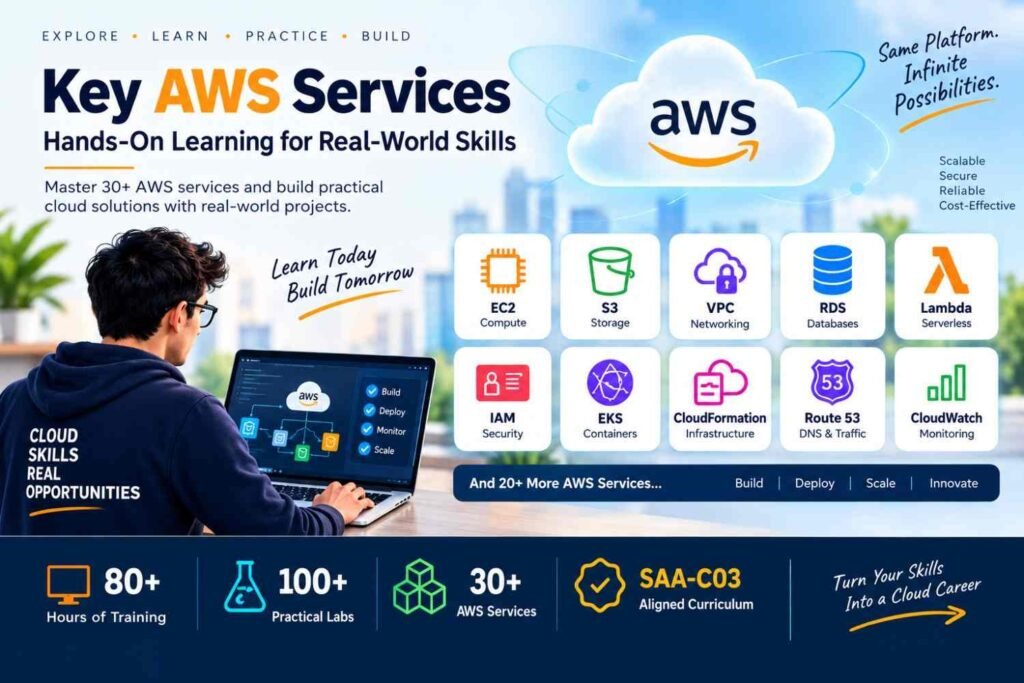
During the training program, learners work with a range of AWS services across compute, storage, networking, databases, security, monitoring, and application delivery.
Key services include:
- IAM
- EC2
- S3
- VPC
- EBS
- KMS
- CloudWatch
- CloudTrail
- Route 53
- CloudFront
- Lambda
- API Gateway
- CloudFormation
- RDS
- DynamoDB
The brochure states that the program covers 30+ AWS services, providing learners with exposure across multiple areas of cloud architecture.
AWS SAA-C03 Certification Preparation
The program is aligned with the AWS Certified Solutions Architect – Associate (SAA-C03) exam.
Certification preparation is integrated into the curriculum through domain-wise practice and exam-focused learning.
Exam Preparation Includes
- Domain-wise practice sets
- Concept explanations
- Practical AWS exercises
- Question-dissection techniques
- Time-management strategies
- 3 full-length mock exams
- 60 questions per mock exam
- Detailed review of practice performance
- Capstone architecture project
The objective is to combine theoretical understanding with practical AWS architecture experience while preparing for the certification exam.
Career Opportunities After AWS Training
Learning AWS can support different career paths depending on a professional’s existing skills, experience, and specialization.
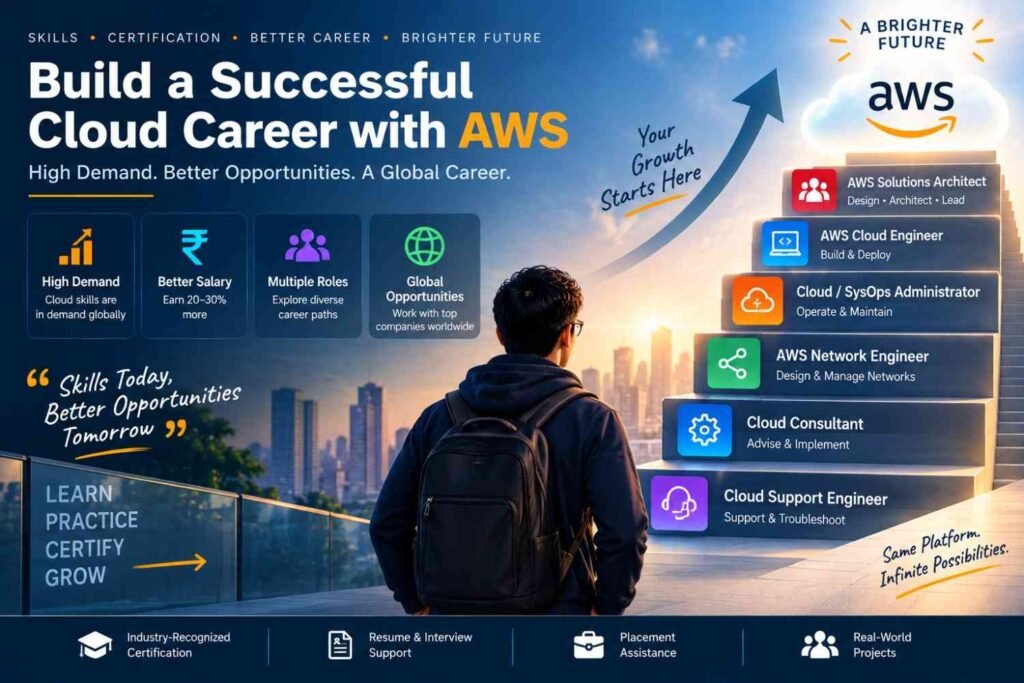
The BinaryBrains brochure identifies several roles that learners can target after developing AWS cloud skills.
AWS Cloud Engineer
Cloud Engineers build, deploy, and maintain cloud infrastructure and applications on AWS.
AWS Solutions Architect
Solutions Architects design secure, scalable, and cost-conscious cloud architectures based on business and technical requirements.
Cloud or SysOps Administrator
This role focuses on day-to-day cloud operations, monitoring, infrastructure management, and troubleshooting.
AWS Network Engineer
AWS Network Engineers work with cloud networking infrastructure and related technologies.
Cloud Consultant
Cloud Consultants can advise organizations on cloud adoption, migration, architecture, and AWS best practices.
Cloud Support Engineer
Cloud Support Engineers help troubleshoot technical issues and support workloads running on AWS.
Industry-Recognised AWS Course Certificate
After successful completion of the training program, learners receive a BinaryBrains Course Completion Certificate.
According to the course brochure, the certificate validates practical skills in AWS cloud architecture, core AWS services, and industry-standard practices for designing secure, resilient, and cost-optimized solutions.
The certificate is intended to support learners when strengthening their professional profile, resume, or preparing for new career opportunities.
Online and Classroom AWS Training Options
The BinaryBrains program offers both live online and classroom training options.
The brochure describes the program as instructor-led, interactive, and supported by recorded access through an online LMS.
The learning format includes:
- 80+ hours of training
- Live instructor-led sessions
- Online learning access
- Classroom training in Pune
- Recorded session access
- Hands-on AWS labs
- Flexible weekday and weekend options
This structure is designed to support students, freshers, working professionals, and career switchers.
Why Practical AWS Training Matters
Reading about AWS services is useful, but cloud architecture becomes easier to understand when learners actually work with the services.
Hands-on AWS labs allow learners to practice tasks such as:
- Creating EC2 instances
- Configuring VPC networks
- Managing IAM permissions
- Creating S3 storage
- Deploying applications
- Configuring load balancing
- Building Auto Scaling environments
- Creating databases
- Monitoring AWS resources
- Building serverless applications
- Managing infrastructure with CloudFormation
The BinaryBrains program includes 100+ practical labs and real-world AWS projects as part of the learning experience.
AWS Solutions Architect Course in Pune
For learners looking for classroom-based cloud training, BinaryBrains offers AWS Solutions Architect training in Pune.
The program combines instructor-led learning with practical AWS labs, projects, certification preparation, and career support.
Learners can work with AWS services across:
- Compute
- Storage
- Networking
- Databases
- Security
- Monitoring
- Automation
- High availability
- Disaster recovery
- Cost optimization
The classroom option is designed for learners who prefer structured, instructor-led training while working directly on practical cloud scenarios.
Career and Placement Support
Technical training is only one part of preparing for a cloud career. The BinaryBrains program also includes career and placement support.
The brochure highlights support areas such as:
- Resume building
- Interview preparation
- Career guidance
- Placement readiness
- Practical project experience
These activities are designed to help learners present their AWS skills and project experience more effectively when preparing for cloud-related opportunities.
Start Your AWS Cloud Career with BinaryBrains
Building a cloud career requires a combination of AWS knowledge, practical experience, architecture skills, and certification preparation.
The BinaryBrains AWS Solutions Architect – Associate program provides a structured learning path covering 30+ AWS services, 100+ practical labs, 80+ hours of training, real-world projects, and SAA-C03 exam preparation.
Whether you are a fresher, IT professional, system administrator, developer, DevOps enthusiast, or career switcher, the program is designed to help you build practical AWS cloud skills.
Ready to start your AWS cloud journey?
Conclusion
An AWS Solutions Architect Course can provide a structured path for learning cloud computing and AWS architecture.
From cloud fundamentals and IAM to VPC networking, EC2, S3, databases, security, monitoring, disaster recovery, cost optimization, and the AWS Well-Architected Framework, the skills covered in this learning path are designed around practical cloud architecture.
The BinaryBrains AWS SAA-C03 program combines 80+ hours of training, 100+ practical labs, 30+ AWS services, real-world projects, and certification preparation.
Most importantly, hands-on practice helps learners understand how individual AWS services can be combined to build secure, scalable, resilient, and cost-effective cloud solutions.
If your goal is to develop practical AWS skills and prepare for the AWS Certified Solutions Architect – Associate certification, a structured training program can give you a clear learning path from cloud fundamentals to architecture design.
Comments are closed