

Introduction
Cloud computing has become an essential part of modern IT infrastructure. Businesses of all sizes are moving applications, databases, storage, networking, and business operations to the cloud to improve scalability, security, flexibility, and cost efficiency.
Among the major cloud platforms, Amazon Web Services (AWS) has become one of the most widely used platforms for building and managing cloud solutions.
For students, freshers, IT professionals, system administrators, developers, and career switchers, learning AWS can open opportunities in cloud computing, infrastructure, DevOps, networking, and solutions architecture.
However, simply knowing individual AWS services is not enough. Professionals need practical knowledge of how different services work together to create secure, scalable, highly available, and cost-effective cloud solutions.
This is where AWS Training and Certification becomes valuable.
A structured AWS training program can help learners understand cloud fundamentals, work with real AWS services, practice through hands-on labs, build projects, and prepare for industry-recognised certification exams.
This guide will help you understand:
- What AWS Training and Certification means
- Why learning AWS is important
- What you can learn through AWS training
- Which AWS services are important for cloud careers
- Why hands-on AWS projects matter
- Which career opportunities AWS skills can support
- How AWS certification preparation works
What Is AWS Training and Certification?
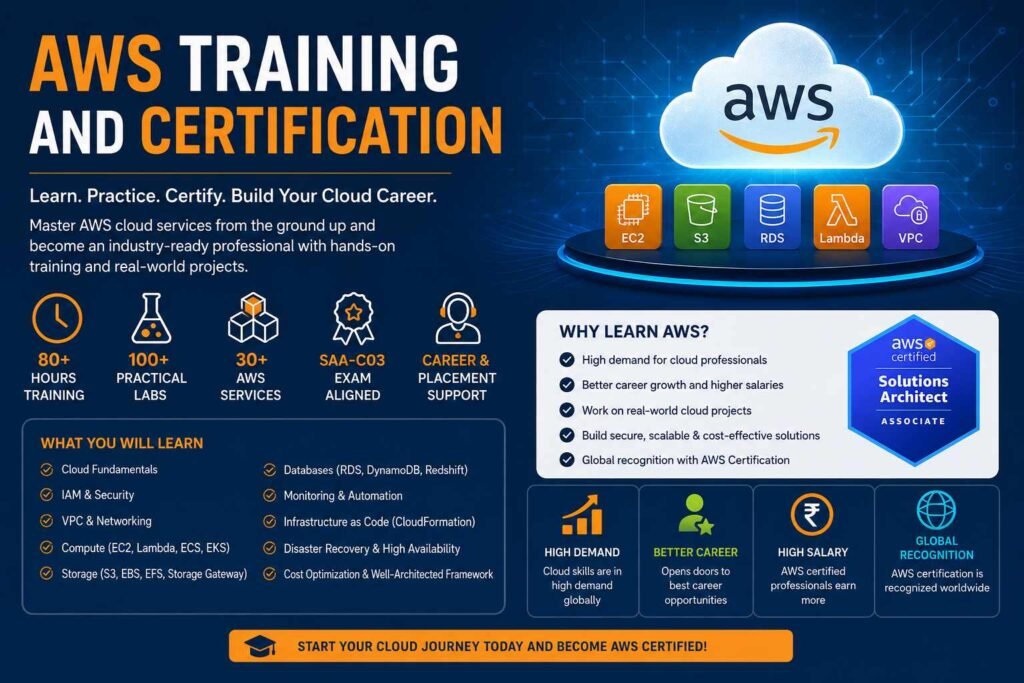
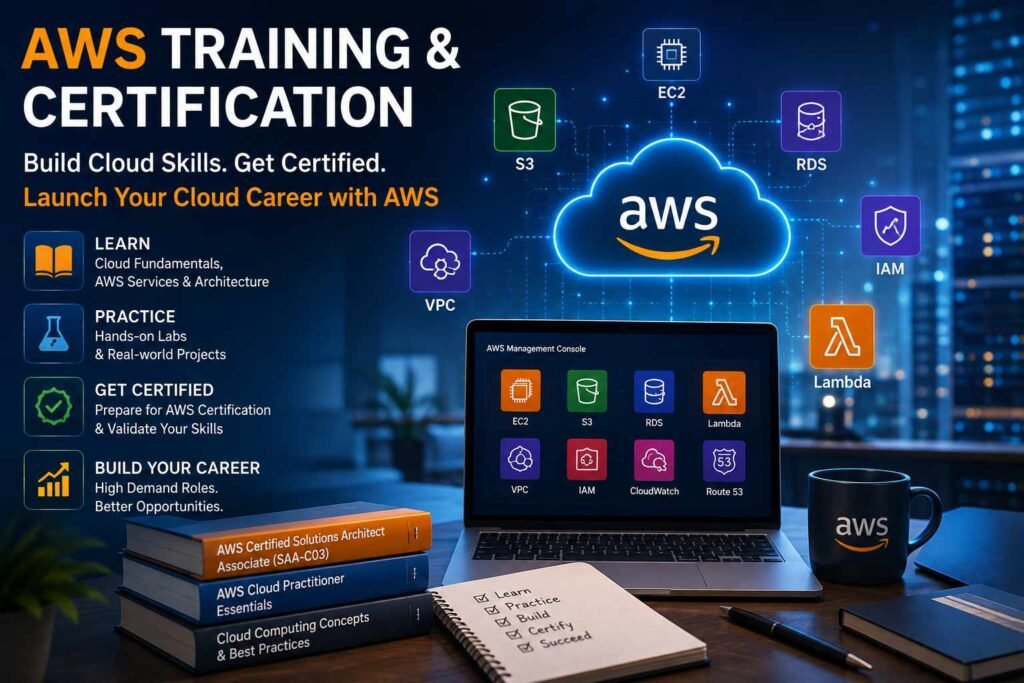
AWS Training and Certification combines structured learning with certification-oriented preparation to help individuals develop practical cloud computing skills.
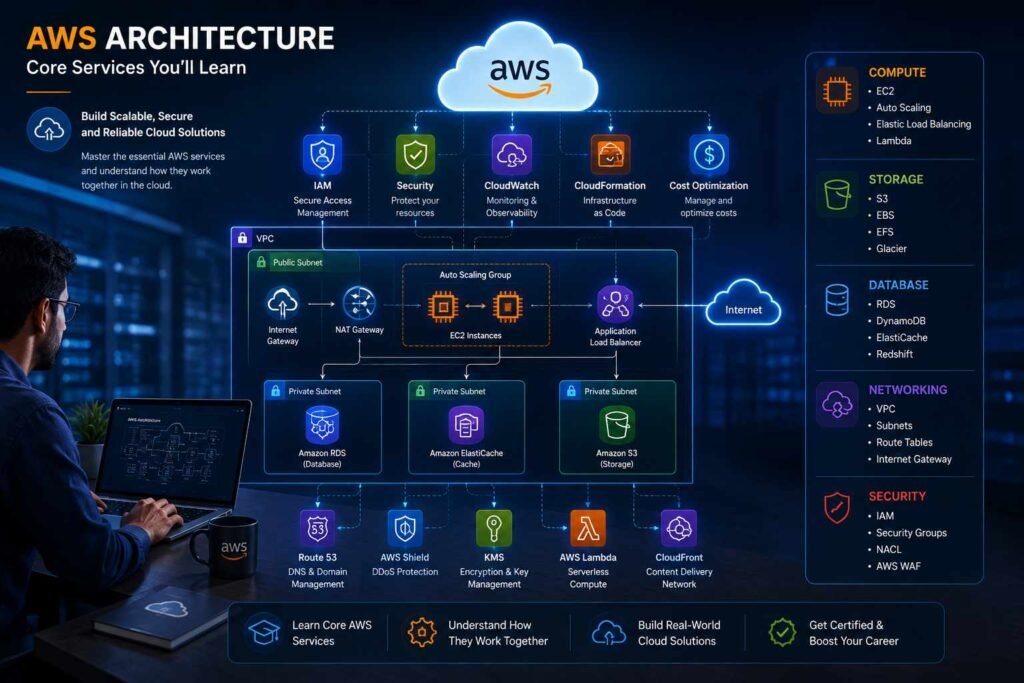
AWS training typically starts with fundamental concepts and gradually moves toward advanced cloud architecture. Learners can understand services such as Amazon EC2, Amazon S3, Amazon VPC, IAM, RDS, Lambda, CloudFront, Route 53, CloudWatch, CloudFormation, and many other AWS technologies.
The AWS Certified Solutions Architect – Associate (SAA-C03) curriculum is particularly focused on designing scalable, secure, and cost-effective cloud solutions.
A structured program based on this syllabus can provide learners with both theoretical understanding and practical exposure to AWS environments.
A strong AWS Training Course should not focus only on passing an examination. It should also help learners understand how AWS services are used in real-world infrastructure and application environments.
Why Learn AWS?
The adoption of cloud computing has created a growing need for professionals who understand cloud infrastructure and architecture.
Organisations need people who can deploy applications, configure networks, manage cloud resources, implement security controls, monitor infrastructure, optimise costs, and design reliable architectures.
AWS knowledge can be useful for professionals working in:
- Cloud computing
- Infrastructure management
- Networking
- DevOps
- System administration
- Application deployment
- Cloud security
- Solutions architecture
- Technical support
- Cloud consulting
The AWS curriculum also highlights practical architecture skills that can help learners build knowledge relevant to modern cloud environments.
For beginners, AWS Training and Certification can also provide a pathway from traditional IT roles into cloud-focused positions.
AWS Training Curriculum: What Will You Learn?
A comprehensive AWS Training and Certification program should cover the major concepts required for cloud architecture.
The SAA-C03-aligned curriculum includes several important areas, beginning with cloud fundamentals and progressing toward networking, compute, storage, databases, security, monitoring, automation, architecture, and practical projects.
This structured approach helps learners understand not only individual AWS services, but also how different services work together to build complete cloud solutions.
The major areas covered include:
- Cloud and AWS foundations
- Identity and Access Management
- Amazon VPC and networking
- Compute services
- AWS storage services
- Database services
- Monitoring and automation
- Infrastructure as Code
- AWS security and compliance
- CDN and global applications
- High availability and disaster recovery
- AWS cost optimisation
- AWS architecture patterns
- AWS Well-Architected Framework
- Hands-on AWS projects
1. Cloud and AWS Foundations
The first stage of AWS Training is understanding cloud computing fundamentals.
Learners explore concepts such as:
- Cloud computing
- IaaS, PaaS, and SaaS
- Public cloud
- Private cloud
- Hybrid cloud
- AWS global infrastructure
- Core AWS concepts
Understanding these foundations makes it easier to learn individual AWS services and understand how they fit into an overall cloud architecture.
Instead of memorising individual services, learners can begin understanding why a particular service is selected for a specific business or technical requirement.
2. Identity and Access Management
Security starts with controlling who can access cloud resources. AWS Identity and Access Management (IAM) is therefore an important part of AWS cloud training.
Learners explore:
- IAM users, groups, roles, and policies
- IAM roles
- Cross-account access
- Multi-factor authentication
- Access keys
- Policy evaluation
- Least-privilege access
- AWS Organizations
- Service Control Policies
- IAM Identity Center
- STS and federation
These concepts help learners understand how access to AWS resources can be controlled securely.
Understanding IAM is especially important because cloud security depends heavily on correctly managing identities, permissions, roles, and access policies.
3. Amazon VPC and Networking
Networking is one of the most important foundations of AWS architecture.
The curriculum covers Amazon Virtual Private Cloud (VPC) and related networking concepts.
Learners work with:
- VPCs
- Subnets
- Route tables
- Internet gateways
- NAT gateways
- Security groups
- Network ACLs
- VPC peering
- Transit Gateway
- VPC endpoints
- PrivateLink
- VPN
- Direct Connect
- Route 53
Understanding these components allows learners to design private and public cloud environments according to application requirements.
Networking knowledge also becomes important when designing secure architectures, connecting applications, controlling traffic, and troubleshooting cloud infrastructure.
4. Compute Services
AWS provides several compute options for hosting applications and workloads.
The AWS Training curriculum covers Amazon EC2 and related technologies, including:
- EC2 instances
- Amazon Machine Images
- Instance metadata
- Elastic Load Balancing
- Application Load Balancer
- Network Load Balancer
- Gateway Load Balancer
- Auto Scaling
- Launch templates
- Lambda
- ECS
- EKS
- Fargate
Learners also understand different EC2 purchasing options such as On-Demand, Reserved Instances, Spot Instances, and Savings Plans.
This knowledge is useful when designing applications that need flexibility, scalability, reliability, and automatic scaling.
5. AWS Storage Services
Data storage is another essential part of cloud architecture. The syllabus covers Amazon S3 and other AWS storage solutions.
Key areas include:
- Amazon S3
- S3 storage classes
- Versioning
- Lifecycle policies
- Replication
- S3 security
- Presigned URLs
- Amazon EBS
- Amazon EFS
- Amazon FSx
- AWS Backup
- Storage Gateway
- DataSync
- Snow Family
Learners understand how different storage services can be selected according to performance, availability, security, and cost requirements.
6. Database Services
Modern applications depend heavily on databases. AWS offers multiple database technologies for different workloads.
The AWS Training and Certification curriculum covers:
- Amazon RDS
- Multi-AZ deployments
- Read replicas
- Amazon Aurora
- Aurora Serverless
- Amazon DynamoDB
- Global and local secondary indexes
- DAX
- ElastiCache
- Redis
- Memcached
- Amazon Redshift
- Amazon Neptune
- Database Migration Service
The objective is to understand how to select and architect databases according to application requirements, scalability, availability, and performance.
Monitoring, Automation and Infrastructure as Code
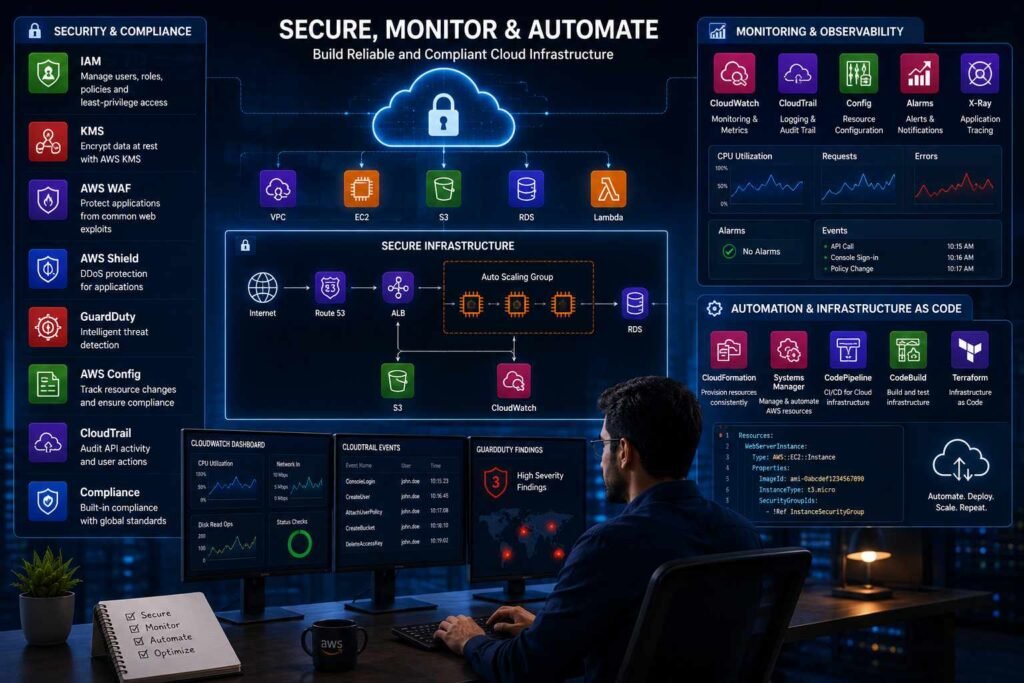
Managing a cloud environment requires continuous monitoring, automation, and visibility. As AWS environments become larger and more complex, cloud professionals need tools that can help them track resources, identify operational issues, and manage infrastructure efficiently.
As part of AWS Training and Certification, learners can develop knowledge of tools such as:
- Amazon CloudWatch
- AWS CloudTrail
- AWS Config
- AWS Systems Manager
- Parameter Store
- AWS Trusted Advisor
- AWS Health Dashboard
- AWS CloudFormation
AWS CloudFormation is particularly useful for Infrastructure as Code because it allows infrastructure to be defined and managed through templates.
Monitoring tools help organisations identify operational issues, track performance, maintain visibility, and improve overall cloud management.
AWS Security, Encryption and Compliance
Security is a core component of cloud architecture. As organisations move applications and data to the cloud, they need to protect identities, networks, applications, and information.
The SAA-C03-aligned AWS curriculum includes several important security services and concepts.
These include:
- AWS KMS
- CloudHSM
- ACM certificates
- AWS WAF
- AWS Shield
- Firewall Manager
- Amazon GuardDuty
- Amazon Inspector
- Amazon Macie
- AWS Security Hub
- Network Firewall
- Secrets Manager
- Parameter Store
Learners also study encryption and AWS security best practices.
This helps them understand how secure cloud architectures can be designed while protecting applications, identities, networks, and data.
Edge Computing, CDN and Global Applications
Applications serving users across different geographic locations need solutions that improve performance and global availability.
A comprehensive AWS Training Course introduces services and concepts that help professionals design applications for users in different locations.
The curriculum includes:
- Amazon CloudFront
- CloudFront caching
- Origin Access Control
- Signed URLs
- Signed cookies
- Route 53
- Routing policies
- Global Accelerator
- Lambda@Edge
- CloudFront Functions
- Multi-region application design
These technologies help architects design applications that can deliver content efficiently to users across different geographic locations.
High Availability and Disaster Recovery
Reliable applications need to continue operating even when individual resources or components fail.
Therefore, high availability and disaster recovery are important concepts for AWS cloud professionals.
The AWS syllabus covers:
- High-availability architecture
- Backup strategies
- Pilot light
- Warm standby
- Multi-site active-active architecture
- Route 53 health checks
- Failover
- Cross-region backup
- Cross-region replication
- Recovery Point Objective (RPO)
- Recovery Time Objective (RTO)
Understanding these concepts helps learners design resilient AWS architectures that are better prepared for unexpected failures and service disruptions.
AWS Cost Optimization
Cloud architecture is not only about performance and security. Cost optimization is also an important consideration when designing and managing AWS infrastructure.
The curriculum introduces:
- AWS pricing fundamentals
- Cost Explorer
- AWS Budgets
- Cost and Usage Reports
- Compute Optimizer
- Trusted Advisor
- Data transfer costs
- Savings Plans
- Reserved Instances
- Spot Instances
- S3 lifecycle savings
A good cloud professional should be able to balance performance, availability, security, and cost.
Understanding AWS pricing and optimization strategies can help organisations make better infrastructure decisions while managing cloud expenditure.
AWS Architecture Patterns and Well-Architected Framework
The AWS Well-Architected Framework helps architects evaluate cloud workloads against important architectural principles.
The curriculum includes:
- Well-Architected design reviews
- Three-tier web application architecture
- Serverless architecture
- Event-driven architecture
- Migration strategies
- Analytics services
- AI and Machine Learning services awareness
Learners can use these concepts to understand how different AWS services work together to create complete solutions rather than learning each service independently.
This architectural approach helps learners think about scalability, security, reliability, performance, operational efficiency, and cost when designing cloud solutions.
Hands-On AWS Projects
Practical experience is one of the most important parts of AWS Training and Certification.
Reading documentation can help learners understand AWS services, but hands-on projects provide an opportunity to apply those concepts in realistic cloud architecture scenarios.
The syllabus includes several real-world projects designed around common AWS infrastructure and application requirements.
Highly Available 3-Tier Web Application
Learners can deploy a web application across multiple Availability Zones using Amazon EC2, Auto Scaling, Application Load Balancer, and Multi-AZ RDS.
This project helps learners understand how multiple AWS services can work together to create a scalable and highly available application architecture.
Secure Custom VPC Network
This project involves creating public and private subnets, NAT gateways, security groups, and VPC endpoints to build a controlled network environment.
It provides practical exposure to AWS VPC networking and helps learners understand how cloud network components work together.
Static Website with Global CDN
Learners can host a website on Amazon S3 and distribute it globally using Amazon CloudFront, with Route 53 used for DNS and routing.
This project demonstrates how AWS storage, CDN, and DNS services can work together to deliver web content efficiently.
Infrastructure as Code Deployment
Using AWS CloudFormation, learners can provision cloud infrastructure through templates while integrating monitoring through CloudWatch and auditing through CloudTrail.
This project provides practical exposure to Infrastructure as Code and automated cloud resource management.
Serverless URL Shortener
This project combines Amazon API Gateway, AWS Lambda, and Amazon DynamoDB to create a serverless URL-shortening application.
It helps learners understand how managed and serverless AWS services can be combined to build an application without managing traditional servers.
Decoupled Image Processing Pipeline
Learners can build an event-driven processing workflow where S3 uploads trigger Lambda through services such as SNS and SQS.
This project introduces learners to event-driven architecture and demonstrates how AWS services can be connected to create automated processing workflows.
These projects provide practical exposure to the type of AWS architecture concepts used in real cloud environments.
Who Should Join AWS Training?
AWS Training and Certification can be suitable for a wide range of learners who want to develop practical cloud computing and architecture skills.
Freshers and Career Switchers
Students and career switchers can begin with cloud fundamentals and gradually build their technical knowledge.
IT Professionals
Developers, testers, support engineers, and other IT professionals can use AWS skills to move toward cloud-focused roles.
System and Network Administrators
Professionals with infrastructure or networking experience can extend their existing skills into cloud environments.
DevOps Enthusiasts
AWS provides an important foundation for professionals interested in automation, CI/CD, containers, and DevOps.
IT Managers and Leads
Managers can develop a stronger understanding of cloud architecture and add a recognised AWS credential to their professional profile.
Entrepreneurs and Freelancers
People building applications or managing digital products can learn how to deploy and scale solutions on AWS.
Career Opportunities After AWS Training
Completing AWS Training and developing practical cloud skills can prepare learners for different technology roles.
Potential career paths include:
- AWS Cloud Engineer
- AWS Solutions Architect
- Cloud/SysOps Administrator
- AWS Network Engineer
- Cloud Consultant
- Cloud Support Engineer
The exact role and compensation depend on experience, skills, location, certifications, and practical knowledge.
Practical experience is particularly important because employers often look beyond certification and evaluate how candidates understand and apply cloud technologies.
AWS Certification Preparation
Certification preparation is another important part of a structured AWS Training and Certification program.
The SAA-C03-oriented curriculum includes:
- Domain-wise practice sets
- Mock examinations
- Exam-focused guidance
- Question-dissection techniques
- Time-management strategies
- Capstone architecture project
The program described in the syllabus includes three full-length mock exams and exam-readiness preparation.
Learners should combine theoretical study, hands-on practice, revision, practice questions, and mock assessments instead of relying only on memorisation.
Do You Need Coding Experience to Learn AWS?
Not necessarily. You do not need to be an experienced programmer to begin learning AWS.
The course curriculum is designed to start with foundational concepts and progressively introduce learners to cloud architecture, AWS services, networking, security, deployment, and best practices.
The syllabus specifically states that prior programming experience is not mandatory. Learners can build their knowledge from networking and Linux fundamentals before moving toward advanced AWS concepts.
However, having basic knowledge of the following areas can make the learning process easier:
- Networking fundamentals
- Operating systems
- Linux basics
- Basic IT concepts
The important thing is to develop your understanding step by step and gain practical experience while learning AWS.
Why Choose Practical AWS Training?
Watching videos or reading documentation can introduce AWS concepts, but practical labs allow learners to understand how cloud services behave in real environments.
Hands-on AWS Training can help learners:
- Configure cloud resources
- Build networks
- Deploy applications
- Work with databases
- Implement security controls
- Monitor cloud infrastructure
- Troubleshoot common issues
- Understand architecture decisions
- Build portfolio projects
Practical training is particularly useful because AWS services are interconnected. Learners need to understand not only what a service does, but also how it works with other services within a complete cloud architecture.
For example, a practical project may require learners to configure networking, deploy compute resources, connect databases, implement security, and monitor the application.
This type of experience can help bridge the gap between learning AWS concepts and applying them to real-world cloud scenarios.
80+ Hours of Training and 100+ Practical Labs
A structured AWS Training and Certification program should provide enough time for both theoretical learning and practical implementation.
The syllabus includes 80+ hours of training and 100+ practical labs, providing learners with hands-on exposure to AWS environments.
The practical learning experience covers real AWS services and cloud architecture scenarios rather than focusing only on theoretical concepts.
Hands-on practice can help learners become more comfortable with:
- AWS resource configuration
- Cloud networking
- Application deployment
- Storage and databases
- Security configuration
- Monitoring and troubleshooting
- Cloud architecture decisions
- Infrastructure management
The program also provides hands-on exposure across 30+ AWS services, helping learners develop broader practical knowledge of the AWS ecosystem.
How AWS Training Can Support Your Cloud Career
Learning AWS can provide a foundation for professionals who want to work with cloud infrastructure, architecture, networking, security, DevOps, and application deployment.
However, completing a course or certification alone does not guarantee a specific job or salary.
Your career progression can depend on:
- Technical skills
- Hands-on experience
- Projects
- Certifications
- Problem-solving ability
- Interview performance
- Professional experience
This is why combining AWS certification preparation with practical projects can help create a stronger technical profile.
Instead of learning AWS services in isolation, learners should focus on understanding how those services can be combined to solve real cloud infrastructure and application requirements.
How to Choose the Right AWS Training Program
Not every AWS course provides the same learning experience. Before choosing an AWS Training Course, it is important to look beyond the course duration or certificate.
Look for a program that provides:
- Structured AWS curriculum
- Hands-on cloud labs
- Real-world AWS projects
- Architecture-focused learning
- Security and networking concepts
- Monitoring and troubleshooting
- Infrastructure as Code
- Certification preparation
- Mock examinations
- Career and placement support
A strong training program should help you understand why and when to use AWS services, rather than simply asking you to memorise service definitions.
Practical implementation is especially important for learners who want to build job-ready cloud skills.
Conclusion
AWS has become an important technology platform for modern cloud infrastructure, and learning it can help IT professionals develop skills relevant to cloud computing, architecture, networking, security, DevOps, and infrastructure management.
A well-structured AWS Training and Certification program should go beyond basic service definitions. It should teach learners how AWS services work together, how to design secure and scalable architectures, how to optimise cloud costs, and how to solve real-world infrastructure challenges.
The SAA-C03-aligned curriculum provides a broad learning path covering cloud foundations, IAM, VPC networking, compute, storage, databases, monitoring, automation, security, CDN, disaster recovery, cost optimisation, architecture patterns, and practical projects.
For beginners, freshers, working IT professionals, system administrators, network professionals, and career switchers, structured AWS learning combined with hands-on practice can be a strong step toward building practical cloud skills and preparing for AWS certification.
If your goal is to move into cloud computing or strengthen your existing IT career, starting with comprehensive AWS Training and Certification can help you build the technical foundation needed to work with one of the industry’s leading cloud platforms.
Ready to Build Your AWS Cloud Career?
Want to develop practical skills in AWS Cloud Computing, cloud architecture, networking, security, monitoring, and infrastructure management?
A structured learning program can help you move from AWS fundamentals to hands-on cloud projects and certification preparation.
Build practical knowledge, work with real AWS services, strengthen your cloud architecture skills, and prepare for your next career opportunity.
Start your AWS learning journey today.
Comments are closed