

Introduction
The IT industry is rapidly moving toward cloud-native applications, automation, continuous delivery, and intelligent operations. At the same time, Generative AI for DevOps is changing how organizations approach software development, infrastructure management, automation, troubleshooting, and operational efficiency. As organizations adopt cloud platforms and modern software development practices, the demand for skilled DevOps engineers continues to grow.
At the same time, Generative AI is changing how technology professionals write code, troubleshoot problems, automate repetitive tasks, analyze incidents, generate documentation, and manage infrastructure. This combination has created a growing career opportunity for professionals who understand both DevOps and Generative AI.
A DevOps Course With Gen AI & Job Assistance can help learners develop these skills through structured learning, practical implementation, AWS cloud technologies, automation tools, AI assistants, and real-world projects.
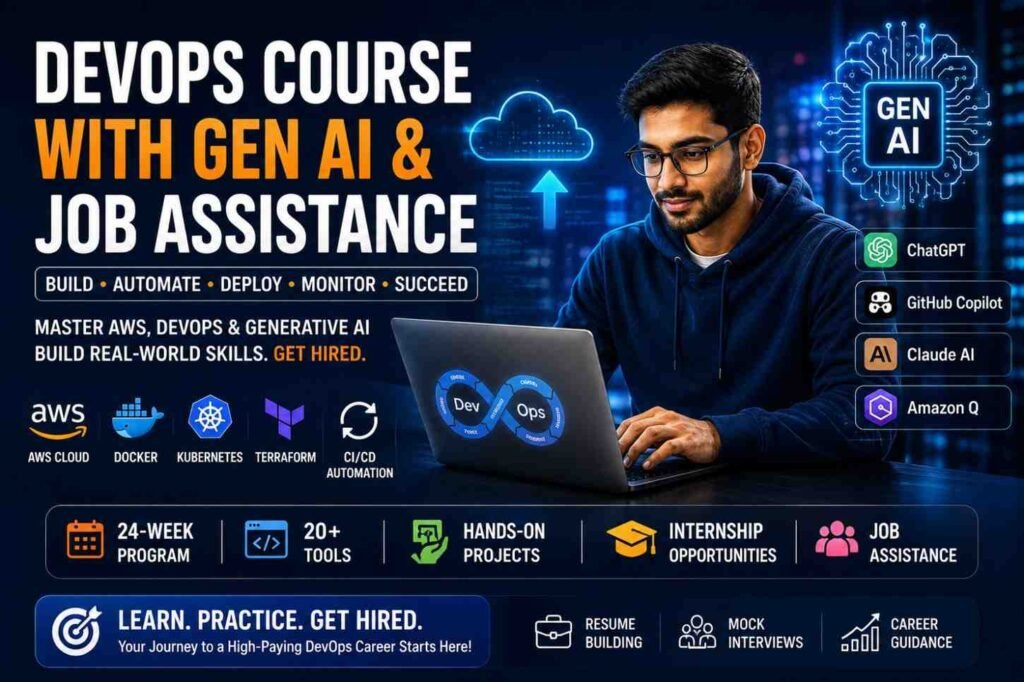
The BinaryBrains AI-Powered DevOps Engineer Program is structured as a 24-week learning journey, covering foundation skills, AWS, core DevOps, advanced DevOps, an enterprise capstone project, and placement and career support. The program also focuses on a modern DevOps toolchain covering 20+ industry-standard tools and technologies.
Whether you’re a fresh graduate, IT professional, system administrator, developer, or aspiring cloud engineer, learning AWS, DevOps, automation, Kubernetes, Infrastructure as Code, and Generative AI can help you develop practical skills aligned with modern technology careers.
In this guide, we’ll explore what you can learn from a DevOps Course With Gen AI & Job Assistance, how AWS and AI fit into modern DevOps workflows, why hands-on projects matter, and how career support can help you prepare for DevOps opportunities.
What Is DevOps?
DevOps is a combination of development and operations practices designed to improve collaboration, automation, software delivery, infrastructure management, and continuous improvement.
Instead of treating software development and IT operations as completely separate functions, DevOps brings them together through processes and technologies such as version control, CI/CD, containerization, Infrastructure as Code, monitoring, and automated deployment.
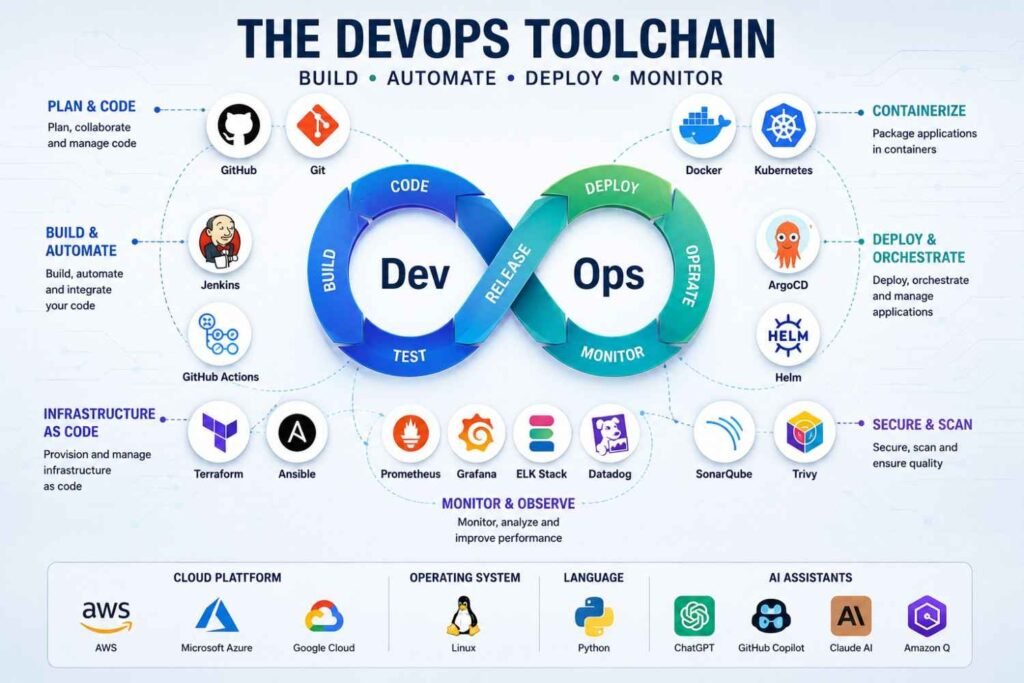
A modern DevOps engineer may work with technologies such as:
- Linux
- Python
- Git and GitHub
- Jenkins
- Docker
- Kubernetes
- Terraform
- Ansible
- AWS
- Prometheus
- Grafana
- ArgoCD
- ELK
- Datadog
These tools help organizations automate software delivery, manage infrastructure, monitor applications, improve reliability, and reduce manual operational work.
The growing adoption of cloud computing and AI is also changing the DevOps skill set. Professionals are increasingly expected to understand not only traditional automation but also how AI-powered tools can improve DevOps workflows.
Why Combine DevOps With Generative AI?
Traditional DevOps already focuses heavily on automation. Generative AI adds another layer by helping engineers work more efficiently with code, scripts, configurations, troubleshooting, documentation, and analysis.
AI tools can assist DevOps professionals with tasks such as:
- Generating Python and shell scripts
- Creating configuration files
- Understanding error messages
- Debugging code
- Generating technical documentation
- Creating infrastructure commands
- Reviewing code
- Analyzing logs
- Supporting incident investigation
- Optimizing cloud infrastructure
- Assisting with deployment automation
For example, an engineer can use an AI assistant to generate an initial Terraform configuration or Kubernetes manifest and then review, modify, test, and deploy it according to the organization’s requirements.
This makes Generative AI for DevOps a valuable complementary skill rather than a replacement for core DevOps knowledge.
The BinaryBrains program introduces AI tools including ChatGPT, Claude AI, GitHub Copilot, and Amazon Q Developer. These tools are used for activities such as code generation, debugging, analysis, AI-assisted programming, cloud assistance, and DevOps workflows.
However, learning Gen AI for DevOps is not simply about knowing how to ask an AI chatbot a question.
Learners also need to understand:
- Prompt engineering
- LLM fundamentals
- AI-assisted code review
- Documentation
- Pipeline integration
- Security considerations
- Responsible use of AI
- Verification of AI-generated output
This combination of technical fundamentals and AI-assisted workflows can help learners become more adaptable as DevOps practices continue to evolve.
What Will You Learn in a DevOps Course With Gen AI & Job Assistance?
A strong DevOps Course With Gen AI & Job Assistance should provide a structured progression from foundational concepts to advanced cloud-native DevOps practices.
The BinaryBrains program follows a structured 24-week learning journey, moving from foundation skills to AWS, core DevOps, advanced DevOps, practical projects, and career support.
Phase 1: Foundation
The first phase builds the technical foundation required for a career in DevOps and Cloud Computing.
It covers:
- Python programming
- Networking fundamentals
- Linux administration
Python for DevOps
Python is widely used for scripting, automation, infrastructure management, and repetitive operational processes.
Learners can develop an understanding of:
- Python syntax
- Control flow
- Functions
- Modules
- Data structures
- File handling
- Error handling
- Libraries
- Basic object-oriented programming
Python can later be used for automation scripts and cloud-related tasks.
AI assistance can also be introduced at the foundation level for command writing, troubleshooting, script generation, and coding support.
Networking Fundamentals
Networking knowledge is essential for DevOps professionals because applications, servers, containers, and cloud services depend on reliable network communication.
Important concepts include:
- IP addressing
- DNS
- TCP/IP
- Network protocols
- Ports
- SSL/TLS
- Subnetting
- Network devices
- Load balancing
Understanding these fundamentals makes it easier to troubleshoot connectivity issues and design reliable cloud environments.
Linux Administration
Linux is an important foundation for DevOps and cloud infrastructure.
Learners can work with:
- Linux file systems
- Linux commands
- Users and permissions
- Processes
- Services
- Package management
- Shell scripting
- Server administration
These skills provide the foundation required for working with cloud servers, containers, automation tools, and deployment environments.
Phase 2: AWS Deep Dive
Cloud computing is an essential component of modern DevOps, and AWS DevOps Training provides learners with practical knowledge of cloud infrastructure and services.
The program covers AWS services and concepts including:
- IAM
- EC2
- S3
- VPC
- Elastic Load Balancing
- Auto Scaling
- CloudWatch
- KMS
AWS Fundamentals
Learners explore AWS fundamentals, regions, availability zones, cloud infrastructure, and essential AWS services.
They also learn how AWS resources can be configured and managed to support modern applications.
IAM
Identity and Access Management helps control who can access AWS resources and what actions they can perform.
Learners explore:
- Users
- Roles
- Permissions
- Access policies
- Security practices
Amazon EC2
EC2 provides scalable virtual computing resources.
Learners can understand how to launch and manage instances, configure environments, and deploy applications on AWS infrastructure.
Amazon S3
Amazon S3 provides cloud object storage for applications, backups, files, and other data.
Understanding S3 is important for DevOps professionals working with cloud-based applications and infrastructure.
VPC and Networking
Virtual Private Cloud provides networking capabilities for AWS resources.
Learners explore concepts such as:
- VPC architecture
- Subnets
- Security
- Network connectivity
- Load balancing
CloudWatch and Monitoring
AWS CloudWatch helps monitor resources and applications.
Learners explore monitoring, metrics, alarms, and operational visibility.
Amazon Q Developer
Amazon Q Developer is integrated into the learning experience to assist with activities such as:
- Code suggestions
- AWS CLI commands
- Infrastructure as Code
- Troubleshooting
- Security guidance
- CI/CD-related assistance
This helps learners understand how AI can support AWS and DevOps workflows.
Phase 3: Core DevOps
The core DevOps phase focuses on the modern DevOps toolchain and software delivery lifecycle.
Git and GitHub Actions
Git is an essential version-control technology used by modern development and DevOps teams.
Learners study:
- Git installation
- Repository management
- Branching
- Merging
- Conflict resolution
- GitHub workflows
They also learn how to create YAML-based GitHub Actions workflows for automated application build and deployment processes.
AI tools can assist with code suggestions, commit messages, workflow creation, and debugging.
Maven
Maven is used for Java application build and dependency management.
Learners explore:
- Maven architecture
- Build lifecycle
- POM files
- Repositories
- Plugins
- Artifact creation
- Jenkins integration
Understanding build automation is important when creating reliable CI/CD workflows.
Jenkins and CI/CD
Jenkins is one of the widely used automation tools in DevOps environments.
Learners explore:
- Jenkins architecture
- Security
- Agents
- Declarative pipelines
- Jenkinsfiles
- Plugins
- Notifications
- Delivery pipelines
The goal is to understand how software can move through automated build, testing, and deployment processes.
AI-assisted pipeline troubleshooting can also help learners understand how AI tools can support CI/CD workflows.
DevSecOps With SonarQube and Trivy
Modern DevOps also requires security.
SonarQube can be used for code quality analysis, while Trivy can be used for container vulnerability scanning.
Learners explore how these tools can be integrated into Jenkins pipelines and how security vulnerabilities can affect software delivery workflows.
This introduces the principles of DevSecOps, where security is incorporated into development and deployment processes rather than being treated as a separate final step.
Docker, Kubernetes and Helm
Containerization is an important part of modern cloud-native infrastructure.
Docker
Learners explore:
- Docker images
- Containers
- Dockerfiles
- Docker CLI
- Registries
- Volumes
- Networking
- Docker Compose
- Container lifecycle management
Docker helps package applications and their dependencies into portable environments.
Kubernetes
Kubernetes provides container orchestration capabilities.
Learners explore:
- Pods
- Deployments
- Services
- Storage
- Secrets
- ConfigMaps
- Scaling
- Rollbacks
These concepts are important for managing containerized applications at scale.
Helm
Helm helps manage Kubernetes applications through charts and reusable deployment configurations.
AI assistance can support activities such as:
- Generating Dockerfiles
- Optimizing containers
- Creating Kubernetes YAML files
- Troubleshooting Kubernetes environments
- Working with Helm charts
However, learners still need to understand the underlying technologies so that AI-generated configurations can be reviewed, tested, secured, and maintained correctly.
GitOps and Monitoring
Modern DevOps environments also rely on GitOps, monitoring, logging, and observability.
The curriculum introduces ArgoCD for GitOps-based deployment workflows.
Learners also explore monitoring using:
- Prometheus
- Grafana
These tools can support:
- Application monitoring
- Dashboards
- Log analysis
- Performance visibility
- Incident detection
- Anomaly detection
- Root-cause analysis
The curriculum also covers ELK and Datadog for centralized logging, application performance monitoring, observability, and operational analysis.
Terraform and Ansible
Infrastructure as Code (IaC) is a major component of modern AWS DevOps environments.
Terraform
Terraform allows infrastructure to be defined and managed through configuration files.
Learners can understand how to automate cloud infrastructure provisioning and manage infrastructure consistently.
Ansible
Ansible is used for server configuration and automation through inventories and playbooks.
Together, Terraform and Ansible help DevOps teams automate infrastructure provisioning and configuration management.
AI can support these workflows by helping generate initial configurations, explain errors, and suggest improvements. However, engineers must understand the underlying infrastructure and security requirements before applying AI-generated configurations.
Phase 4: Advanced DevOps on AWS
After developing core DevOps knowledge, learners move toward advanced AWS container services and operational technologies.
The curriculum covers:
- AWS Fargate
- Amazon ECS
- Amazon ECR
- Amazon EKS
- AIOps
- Splunk
- Dynatrace
AWS Fargate
AWS Fargate allows teams to run containers without directly managing the underlying servers.
This provides learners with experience in serverless container execution and cloud-native application deployment.
Amazon ECS
Amazon Elastic Container Service provides managed container orchestration.
Learners can understand how containerized workloads can be deployed and managed within AWS.
Amazon ECR
Amazon Elastic Container Registry provides a private registry for storing and managing container images.
Understanding ECR is valuable when creating AWS-based Docker and CI/CD workflows.
Amazon EKS
Amazon Elastic Kubernetes Service provides managed Kubernetes on AWS.
Learners explore areas such as:
- Cluster management
- Networking
- Terraform and CloudFormation
- kubectl
- Helm
- Monitoring
- Scaling
- CI/CD pipelines
This gives learners practical exposure to Kubernetes within the AWS ecosystem.
AIOps, Splunk and Dynatrace
Modern organizations are increasingly exploring AIOps, which combines artificial intelligence and IT operations to improve monitoring, issue detection, infrastructure optimization, and incident response.
The program also introduces technologies such as Splunk and Dynatrace for areas including:
- Monitoring
- Observability
- Log analytics
- Performance optimization
- Root-cause analysis
- AI-assisted operational insights
This provides learners with exposure to the growing intersection of AI, cloud operations, monitoring, and DevOps.
Real-World Enterprise Capstone Project
One of the most important parts of a practical DevOps Course With Gen AI & Job Assistance is project-based learning.
Learning individual tools is useful, but understanding how those tools work together is even more important.
The program includes an enterprise capstone project where learners deploy a healthcare application on AWS using modern DevOps and cloud-native technologies.
The project follows a microservices-based architecture and includes multiple application components.
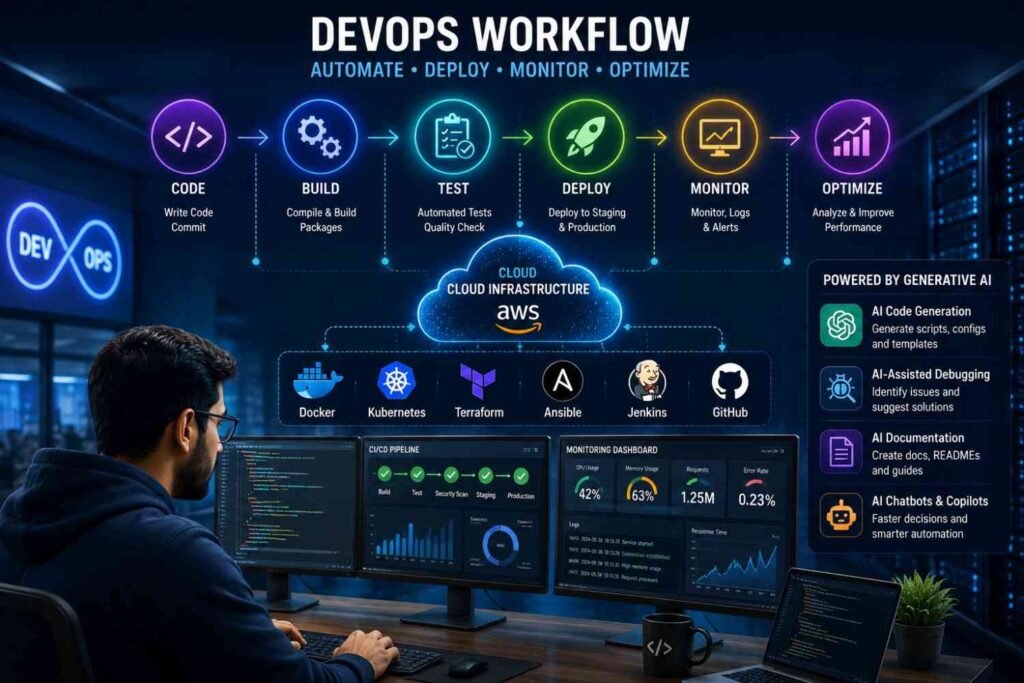
Learners work through the complete DevOps lifecycle:
Code → Build → Containerize → Deploy → Monitor
The project uses technologies such as:
- GitHub/GitLab
- Jenkins or GitHub Actions
- Docker
- Kubernetes
- Amazon ECR
- Prometheus
- Grafana
Another practical project focuses on Kubernetes administration and AWS EKS.
Learners work with technologies including:
- Terraform
- Docker
- Amazon ECR
- eksctl
- kubectl
- Helm
- Prometheus
- Redis
- AWS Load Balancer Controller
- Horizontal Pod Autoscaler
These projects help learners understand how multiple DevOps technologies work together in practical cloud-native environments.

How Generative AI Supports DevOps Learning
Generative AI for DevOps is integrated throughout the program rather than being treated as a standalone topic.
Learners work with several AI tools, including:
ChatGPT
ChatGPT can support:
- AI-assisted code generation
- Scripting
- Troubleshooting
- Documentation
- Infrastructure configuration
- DevOps learning
Claude AI
Claude can assist with:
- Debugging
- Troubleshooting
- Analysis
- Documentation
- Incident-related support
GitHub Copilot
GitHub Copilot provides:
- AI pair programming
- Code suggestions
- Autocomplete
- Coding assistance
- Script development
Amazon Q Developer
Amazon Q Developer provides AWS-focused assistance for areas such as:
- AWS-related questions
- AWS CLI support
- Infrastructure guidance
- Code assistance
- Troubleshooting
- Cloud workflows
The objective is not simply to use AI tools but to understand how they can responsibly support DevOps automation, cloud operations, development workflows, and productivity.
How Generative AI Supports DevOps Learning
Generative AI for DevOps is integrated throughout the program rather than being treated as a standalone topic.
Learners work with several AI tools, including:
ChatGPT
ChatGPT can support:
- AI-assisted code generation
- Scripting
- Troubleshooting
- Documentation
- Infrastructure configuration
- DevOps learning
Claude AI
Claude can assist with:
- Debugging
- Troubleshooting
- Analysis
- Documentation
- Incident-related support
GitHub Copilot
GitHub Copilot provides:
- AI pair programming
- Code suggestions
- Autocomplete
- Coding assistance
- Script development
Amazon Q Developer
Amazon Q Developer provides AWS-focused assistance for areas such as:
- AWS-related questions
- AWS CLI support
- Infrastructure guidance
- Code assistance
- Troubleshooting
- Cloud workflows
The objective is not simply to use AI tools but to understand how they can responsibly support DevOps automation, cloud operations, development workflows, and productivity.
DevOps Career Opportunities
After developing skills across Linux, Python, AWS, CI/CD, containers, Kubernetes, Infrastructure as Code, monitoring, security, and Generative AI, learners can explore career paths related to cloud infrastructure and DevOps.
Potential roles include:
- DevOps Engineer
- AWS DevOps Engineer
- Cloud Engineer
- AWS Engineer
- Cloud DevOps Engineer
- Automation Engineer
- DevSecOps Engineer
- Site Reliability Engineer (SRE)
- Platform Engineer
- Cloud Operations Engineer
- Infrastructure Automation Engineer
The exact role a learner qualifies for depends on their previous education, technical skills, practical experience, interview performance, and individual employer requirements.
The broader career opportunities listed for DevOps training also include DevOps Engineer, Cloud Engineer, AWS Engineer, SRE, Platform Engineer, DevSecOps Engineer, Cloud Operations Engineer, and Infrastructure Automation Engineer.
DevOps Job Assistance and Career Support
Technical skills are only one part of starting a successful DevOps career.
Job preparation is another important component.
A career-focused DevOps Course With Gen AI & Job Assistance should help learners prepare not only for technical interviews but also for the broader recruitment process.
Career support can include:
- Resume building
- Resume review
- LinkedIn profile optimization
- Mock interviews
- Job referrals
- Connections with hiring companies
- Career guidance
- Interview preparation
A strong resume should clearly communicate your technical skills, practical projects, cloud experience, certifications, and internship or project exposure.
Similarly, a professional LinkedIn profile and GitHub portfolio can help demonstrate your technical work to potential employers.
The goal of placement and career support should be to help learners move from learning → project experience → interview preparation → job opportunities.

Who Should Join a DevOps Course With Gen AI & Job Assistance?
A structured DevOps Course With Gen AI & Job Assistance can be suitable for learners who want to build careers around cloud infrastructure, automation, software delivery, and modern IT operations.
It can be relevant for:
- Engineering Students
- BCA/MCA Students
- IT Graduates
- Software Developers
- System Administrators
- Technical Support Engineers
- Working Professionals
- Professionals seeking career growth in Cloud and DevOps
The program is designed to progressively build skills, so learners do not necessarily need to master every DevOps tool before beginning their journey.
The available program material also specifically identifies engineering students, BCA/MCA students, IT graduates, software developers, system administrators, technical support engineers, and working professionals seeking growth in Cloud and DevOps as suitable learner groups.
Why Choose a Structured 24-Week DevOps Learning Journey?
Learning DevOps can be challenging because the ecosystem includes many interconnected technologies.
For example, learning Docker without understanding Linux, networking, application deployment, and containers may provide only partial knowledge.
Similarly, learning Kubernetes without understanding Docker, networking, cloud infrastructure, and deployment concepts can make advanced topics more difficult.
A structured learning journey helps learners progress from foundational concepts toward more advanced technologies.
The BinaryBrains program follows a structured 24-week learning journey that progresses through:
Foundation → AWS Deep Dive → Core DevOps → Advanced DevOps → Enterprise Capstone → Placement & Career Support
This type of progression helps learners build their knowledge step by step rather than trying to learn every DevOps technology simultaneously.
The goal is to connect the different parts of the DevOps ecosystem and show how they work together in practical environments.
Why Choose an AI Powered DevOps Course?
Traditional DevOps training focuses primarily on automation, cloud infrastructure, CI/CD, containers, monitoring, and software delivery.
However, modern technology workflows are increasingly incorporating AI.
An AI Powered DevOps Course combines traditional DevOps fundamentals with emerging AI capabilities.
This approach can help learners understand:
- AWS Cloud
- DevOps Automation
- Infrastructure as Code
- Containerization
- CI/CD
- Monitoring
- Cloud Security
- Generative AI Tools
- AI-assisted Development
- AI-powered Operations
The goal is not to replace core technical knowledge with AI.
Instead, the goal is to develop engineers who understand the fundamentals and can use AI tools responsibly to improve productivity, troubleshooting, automation, and operational efficiency.
As your existing DevOps content also highlights, organizations increasingly value professionals who can combine cloud, automation, and AI skills.
Why Choose BinaryBrains for DevOps With AWS and Gen AI?
Choosing the right DevOps Training Institute is important when your goal is to build practical, job-ready skills.
A strong program should go beyond theoretical concepts and provide structured learning, hands-on implementation, real-world projects, modern DevOps tools, and career support.
The BinaryBrains AI Powered DevOps Course with AWS combines cloud computing, DevOps automation, containerization, Infrastructure as Code, monitoring, security, and Generative AI within a structured learning journey.
The program focuses on practical learning through cloud labs, deployment exercises, automation projects, CI/CD implementation, container orchestration, Infrastructure as Code, and real-world use cases.
The program’s approach is designed to help learners understand how technologies such as AWS, Docker, Kubernetes, Terraform, Jenkins, monitoring tools, and AI assistants work together.
What You Can Learn
The program covers a broad range of modern technologies and concepts, including:
- AWS Cloud Training
- Linux and Python for DevOps
- Git and GitHub
- CI/CD
- Jenkins Automation
- Docker
- Kubernetes
- Terraform
- Ansible
- Prometheus
- Grafana
- ELK
- Datadog
- DevSecOps
- Cloud Security
- Generative AI for DevOps
- ChatGPT
- GitHub Copilot
- Claude AI
- Amazon Q Developer
- AIOps
The combination of these technologies provides learners with exposure to multiple areas of modern cloud and DevOps engineering.
Build Practical DevOps Projects
Practical experience is an important part of becoming job-ready.
The BinaryBrains program includes hands-on learning through cloud labs, deployment exercises, automation projects, CI/CD implementation, container orchestration, Infrastructure as Code, and real-world use cases.
The enterprise capstone project further allows learners to apply multiple DevOps technologies together rather than studying them individually.
This type of project experience can help learners develop:
- Technical confidence
- Troubleshooting skills
- Cloud deployment experience
- Automation knowledge
- Portfolio projects
- Interview discussion points
- Practical understanding of DevOps workflows
Start Your DevOps Career With AWS and Gen AI
If you’re looking for a practical DevOps Course With Gen AI & Job Assistance, the right program should combine technical training with real-world projects, cloud exposure, AI-powered workflows, and career support.
The AI Powered Masters Program in DevOps with AWS is designed for learners who want to build skills across AWS, DevOps, Cloud Computing, automation, Kubernetes, Infrastructure as Code, monitoring, and Generative AI.
Explore the AI Powered Masters Program in DevOps with AWS:
AI Powered Masters Program in DevOps with AWS
For learners specifically searching for DevOps Training in Pune, the Pune-focused program provides a local learning option built around AWS, DevOps, cloud automation, CI/CD, containers, Infrastructure as Code, and AI-driven workflows. The program material specifically positions it for students, fresh graduates, and working professionals seeking job-ready cloud and DevOps skills.
Explore DevOps Training in Pune:
AI Powered Masters Program in DevOps with AWS in Pune
- Book a Free Demo Class:
https://binarybrains.co/book-a-demo-class/ - Call/WhatsApp: +91-7249756356
Conclusion
The technology industry is continuing to move toward cloud computing, automation, containerization, continuous delivery, and intelligent IT operations.
At the same time, Generative AI is changing how developers, cloud engineers, and DevOps professionals approach coding, troubleshooting, documentation, infrastructure, and operational tasks.
This makes the combination of DevOps, AWS, Cloud Computing, Automation, and Generative AI increasingly relevant for professionals who want to build future-ready technology skills.
A DevOps Course With Gen AI & Job Assistance can provide a structured path covering Python, Linux, Networking, AWS, Git, CI/CD, Jenkins, Docker, Kubernetes, Terraform, Ansible, Monitoring, DevSecOps, AIOps, and AI tools such as ChatGPT, Claude AI, GitHub Copilot, and Amazon Q Developer.
However, learning tools alone is not enough.
Practical projects, cloud labs, troubleshooting experience, automation exercises, and career preparation can help learners understand how these technologies are applied in real-world environments.
The BinaryBrains program brings these areas together through a structured learning journey, practical projects, an enterprise capstone, and dedicated placement and career support.
For learners who want to build a career at the intersection of AWS, DevOps, Cloud Computing, Automation, and Generative AI, developing strong technical fundamentals and practical experience can be an important step toward becoming a future-ready technology professional.
Comments are closed