

Introduction
The demand for DevOps professionals continues to grow as organizations accelerate their digital transformation initiatives. Businesses across industries are adopting cloud computing, automation, and Generative AI for DevOps to deliver software faster, improve infrastructure reliability, and enhance customer experiences.
As a result, companies are actively searching for professionals who possess practical DevOps skills and real-world project experience. However, completing a certification alone is no longer enough. Employers now prefer candidates who have worked on live projects, understand modern DevOps tools, and can confidently solve real business challenges.
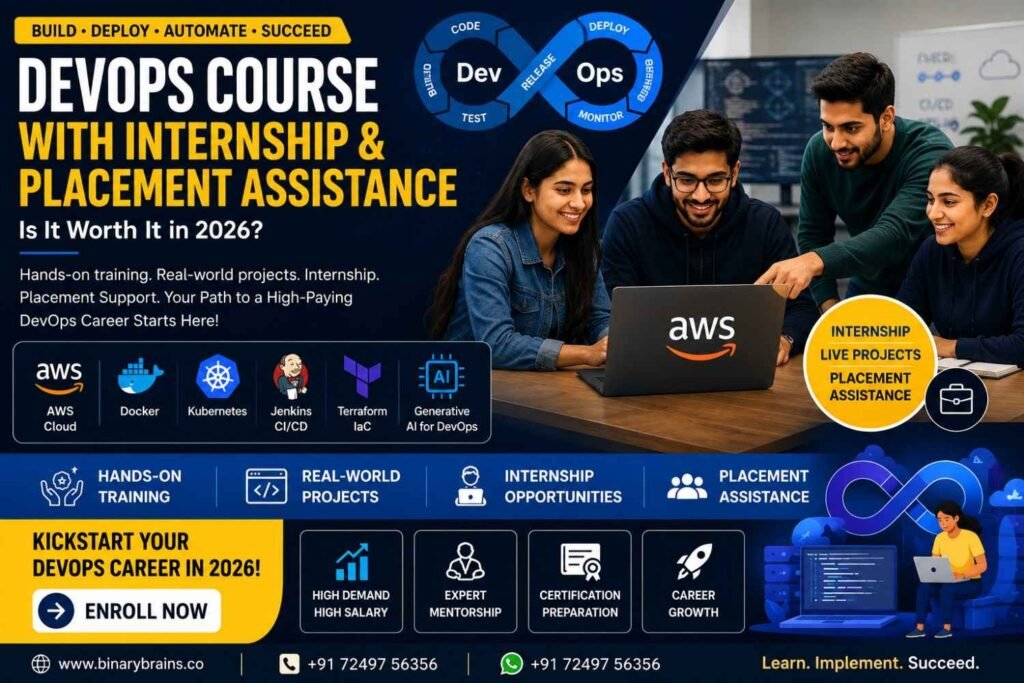
This is why choosing a DevOps Course with Internship and DevOps Placement Assistance has become one of the smartest career decisions for aspiring cloud and DevOps engineers in 2026.
Whether you’re a student, recent graduate, software developer, system administrator, or IT professional looking to switch careers, an internship provides hands-on exposure to industry-standard tools such as AWS, Docker, Kubernetes, Terraform, Jenkins, and CI/CD pipelines. It bridges the gap between classroom learning and real-world implementation.
If you’re looking for an AI Powered DevOps Course with AWS, it’s equally important to choose a training program that includes structured internships, live projects, interview preparation, and placement support. These elements significantly improve your confidence and increase your chances of securing a high-paying DevOps role.
In this guide, you’ll discover why internships matter, what recruiters expect from DevOps candidates, the importance of placement assistance, the value of real-world projects, and how the right training institute can accelerate your cloud career in 2026.
This Guide Will Help You Understand
- Why a DevOps Internship is essential for career growth
- What recruiters expect from DevOps professionals in 2026
- How Placement Assistance improves job opportunities
- Why live industry projects matter more than certifications alone
- Career opportunities after completing a DevOps Course with Placement
- How to choose the Best DevOps Course for long-term success
Why Internship Matters in DevOps Training
One of the biggest challenges faced by fresh graduates and career switchers is gaining practical industry experience. While many candidates complete online certifications, recruiters often prioritize applicants who have worked on real infrastructure, deployed applications, and solved operational challenges in production-like environments.
This is where a DevOps Course with Internship becomes highly valuable. An internship allows learners to apply theoretical concepts in practical scenarios, helping them understand how modern DevOps teams collaborate, automate deployments, manage cloud infrastructure, and maintain application reliability.
Instead of simply watching video tutorials, students gain experience working with industry-standard tools and workflows that are widely used by startups, enterprises, and global technology companies.
Benefits of a DevOps Internship
A structured internship provides much more than technical knowledge. It helps learners develop problem-solving abilities, communication skills, and confidence while working on real-world cloud environments.
During a quality DevOps Internship, students typically gain experience in:
- Deploying applications on Amazon Web Services (AWS)
- Managing Linux servers and cloud infrastructure
- Building automated CI/CD pipelines
- Working with Docker containers and Kubernetes clusters
- Creating Infrastructure as Code (IaC) using Terraform
- Monitoring applications and cloud resources
- Using Git and GitHub for version control
- Implementing automation using Jenkins and GitHub Actions
- Exploring Generative AI for DevOps using tools like ChatGPT and GitHub Copilot
These practical experiences prepare students for the responsibilities they will encounter in professional DevOps roles.
Bridging the Gap Between Learning and Employment
Many learners struggle during technical interviews because they understand concepts but lack hands-on implementation experience. Recruiters frequently ask candidates to explain how they deployed an application, configured a CI/CD pipeline, or managed cloud infrastructure rather than simply defining DevOps concepts.
An internship bridges this gap by allowing students to work on realistic scenarios, troubleshoot deployment issues, configure cloud environments, and automate repetitive operational tasks. This practical exposure builds confidence and makes interview discussions more meaningful.
Learning Through Real Business Scenarios
Professional DevOps teams solve business problems every day. During an internship, students experience how organizations plan infrastructure, manage deployments, maintain security, monitor applications, and optimize cloud costs.
Rather than memorizing commands, learners understand why different tools are used, how they integrate with each other, and how automation improves software delivery across the entire development lifecycle.
Building an Industry-Ready Portfolio
One of the biggest advantages of completing a DevOps Course with Internship is the opportunity to build a professional portfolio. Employers appreciate candidates who can showcase practical projects instead of relying only on certificates.
A strong DevOps portfolio may include:
- AWS cloud deployment projects
- Docker containerization projects
- Kubernetes cluster management
- Terraform Infrastructure as Code implementations
- CI/CD automation pipelines
- Monitoring and logging dashboards
- Cloud security implementation
- AI-assisted DevOps automation projects
These projects demonstrate technical competence, practical experience, and problem-solving abilities, making candidates more attractive to hiring managers.
Preparing for the Future of DevOps
The DevOps landscape is evolving rapidly with the integration of Artificial Intelligence into software development and cloud operations. Organizations now expect engineers to understand automation, cloud computing, Infrastructure as Code, containerization, and AI-powered productivity tools.
Choosing a training program that combines AWS Cloud Training, hands-on internships, and exposure to Generative AI for DevOps helps learners stay aligned with current industry requirements and prepares them for future technology trends.
If you’re planning to build a successful career in cloud computing, enrolling in an AI Powered Masters Program in DevOps with AWS can provide practical training, internship opportunities, and industry-focused learning. Students based in Maharashtra can also explore DevOps Training in Pune for classroom-based, hands-on learning with expert mentors.
What Recruiters Expect from DevOps Candidates in 2026
The hiring landscape for DevOps professionals has changed significantly over the past few years. Companies are no longer looking for candidates who only understand DevOps concepts or hold certifications. Instead, they want professionals who can confidently apply their knowledge to solve real business challenges, automate workflows, and manage cloud infrastructure efficiently.
Whether you’re applying for an internship or a full-time role, recruiters evaluate your practical skills, problem-solving ability, communication, and understanding of modern DevOps technologies.
This is why enrolling in a DevOps Course with Internship provides a significant advantage over learning through theory alone. Organizations across startups, product-based companies, and multinational enterprises increasingly seek professionals who can contribute from day one. Candidates with hands-on experience and project-based learning often stand out during the recruitment process.
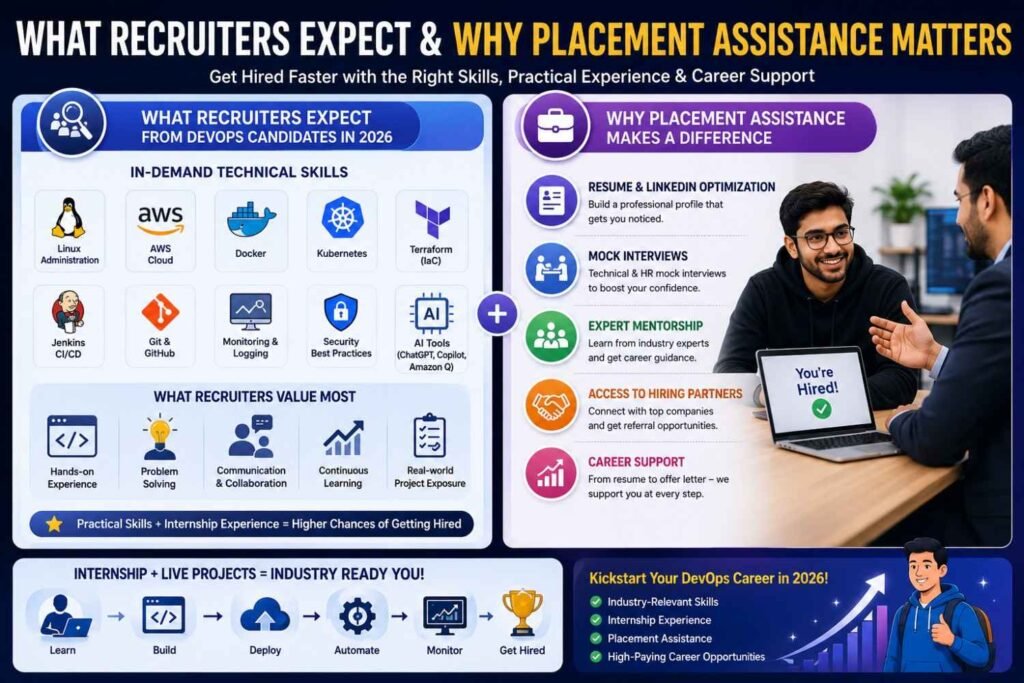
Technical Skills Recruiters Look For
A successful DevOps engineer should possess expertise across multiple technologies rather than relying on a single tool. Recruiters expect candidates to understand the complete software delivery lifecycle, from infrastructure provisioning to application deployment and monitoring.
Some of the most in-demand technical skills include:
- Linux Administration
- Amazon Web Services (AWS)
- Docker Containerization
- Kubernetes Cluster Management
- Terraform Infrastructure as Code (IaC)
- Jenkins CI/CD Pipelines
- Git & GitHub Version Control
- Cloud Monitoring & Logging
- Networking Fundamentals
- Cloud Security Best Practices
Having practical experience with these technologies demonstrates your ability to work in modern cloud environments and manage production-ready infrastructure.
The Growing Importance of AI Skills
As businesses embrace intelligent automation, recruiters are increasingly interested in candidates who understand Generative AI for DevOps. AI tools are now helping engineers write scripts, automate repetitive tasks, troubleshoot deployment issues, generate documentation, and optimize cloud infrastructure.
Candidates who know how to use tools such as ChatGPT, GitHub Copilot, and Amazon Q alongside traditional DevOps practices are becoming more valuable in today’s competitive job market.
Learning how AI integrates with DevOps not only improves productivity but also demonstrates that you’re prepared for the future of cloud engineering.
Problem-Solving Matters More Than Memorization
Technical interviews rarely focus only on definitions. Instead, recruiters assess how candidates approach real-world problems, troubleshoot deployment failures, optimize infrastructure, and automate operational tasks.
For example, you may be asked to explain:
- How to deploy an application on AWS
- How to build a CI/CD pipeline using Jenkins
- How Kubernetes manages containers
- How Terraform provisions cloud infrastructure
- How to troubleshoot deployment failures
- How AI tools improve DevOps productivity
Students who have completed live projects during a DevOps Internship can confidently answer these questions because they have already implemented these solutions in practical environments.
Communication and Team Collaboration
DevOps is built on collaboration between development, operations, quality assurance, and security teams. Recruiters therefore value candidates who can communicate technical ideas clearly, document their work, and collaborate effectively with cross-functional teams.
Strong communication skills become especially important when explaining infrastructure decisions, presenting project work, or participating in incident response discussions.
Continuous Learning Mindset
Technology evolves rapidly, and successful DevOps engineers never stop learning. Recruiters appreciate candidates who stay updated with cloud services, automation tools, container technologies, and emerging AI solutions.
Showing curiosity, participating in personal projects, earning relevant certifications, and continuously improving your skills demonstrates a growth mindset that employers highly value.
Why Placement Assistance Makes a Difference
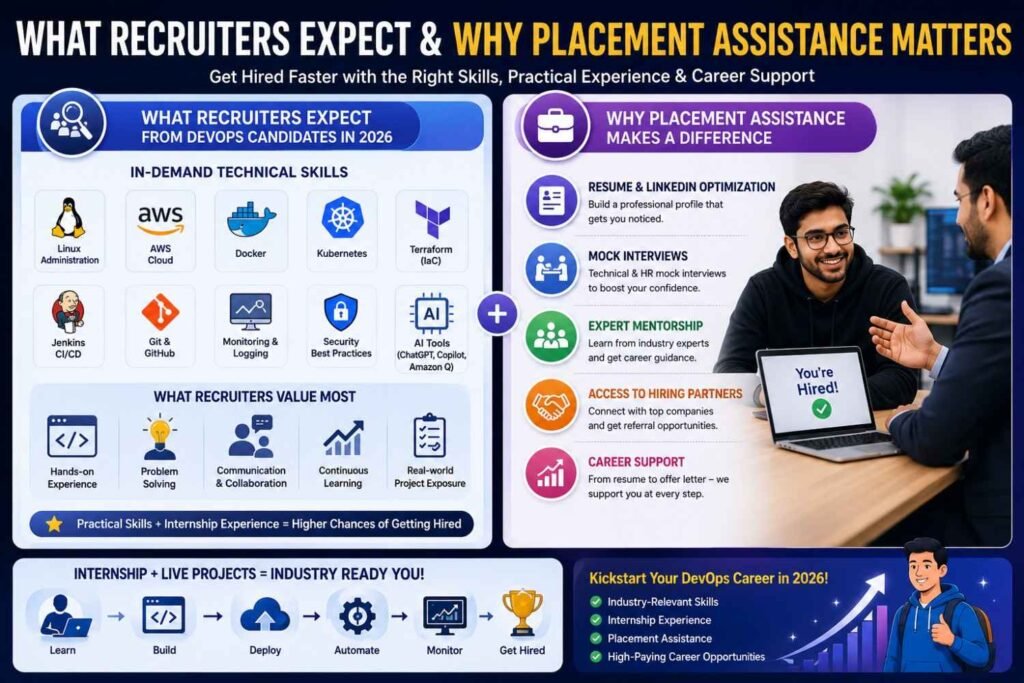
Completing a training program is only one step toward building a successful career. The next challenge is securing interviews, showcasing your skills, and receiving job offers. This is where DevOps Placement Assistance becomes an essential part of your learning journey.
Many talented students struggle to find opportunities because they lack professional guidance during the hiring process. A quality DevOps Training Institute not only teaches technical skills but also prepares students for recruitment through structured career support.
Choosing a DevOps Course with Placement gives learners the confidence to approach interviews with practical experience, polished resumes, and a clear understanding of employer expectations.
Resume Building and Portfolio Development
Your resume creates the first impression during the hiring process. Recruiters often spend only a few seconds reviewing each application, making it important to highlight practical skills, certifications, and project experience effectively.
A strong placement support program helps students build:
- ATS-friendly resumes
- Professional LinkedIn profiles
- GitHub project portfolios
- Cloud deployment case studies
- DevOps project documentation
- Technical portfolios for recruiters
A well-structured portfolio significantly increases your chances of being shortlisted for interviews.
Mock Interviews and Technical Preparation
Interview preparation is one of the most valuable aspects of placement assistance. Mock interviews simulate real hiring scenarios and help candidates improve both technical knowledge and communication skills.
Students receive guidance on topics such as:
- Linux interview questions
- AWS architecture discussions
- Docker and Kubernetes concepts
- Terraform implementation scenarios
- CI/CD pipeline design
- Cloud troubleshooting techniques
- Behavioral interview questions
Practicing these scenarios helps candidates answer confidently during actual interviews.
Industry Mentorship
Learning from experienced DevOps professionals provides valuable insights into industry practices, project execution, and career planning. Mentors help students understand current hiring trends, recommended certifications, salary expectations, and technical skills required for different DevOps roles.
This personalized guidance enables learners to prepare strategically for their desired career path instead of relying on generic online resources.
Access to Hiring Opportunities
One of the biggest advantages of enrolling in a training institute that offers placement assistance is access to hiring networks and recruitment opportunities. Many institutes collaborate with startups, IT service companies, cloud consulting firms, and enterprise organizations looking for skilled DevOps professionals.
Students benefit from:
- Job referrals
- Hiring drives
- Campus recruitment opportunities
- Interview scheduling support
- Career counseling sessions
- Employer networking opportunities
These opportunities help bridge the gap between learning and employment while reducing the time required to secure your first DevOps job.
Choose a Program That Supports Your Career
When selecting a Best DevOps Course, look beyond the syllabus. Evaluate whether the program includes internships, live projects, career mentoring, mock interviews, resume building, and dedicated placement assistance.
If your goal is to become a job-ready DevOps engineer, consider enrolling in the AI Powered Masters Program in DevOps with AWS, which combines practical training, internship opportunities, and career support.
Learners looking for classroom-based learning can also explore the DevOps Training in Pune program for hands-on instruction from industry experts.
By combining technical expertise, practical experience, and structured placement support, you’ll be well-prepared to launch a successful career in cloud computing, DevOps, and AI-powered automation.
Real-World Projects That Make You Job-Ready
One of the biggest differences between an average candidate and a job-ready DevOps professional is practical project experience. While certifications demonstrate theoretical knowledge, recruiters are far more interested in candidates who can showcase real implementations using cloud platforms, automation tools, and modern DevOps practices.
A high-quality DevOps Course with Internship should provide opportunities to work on industry-oriented projects that simulate real business environments. These projects help learners understand how different DevOps tools work together while developing the confidence to solve practical challenges.
Working on live projects also strengthens your portfolio, making it easier to demonstrate your technical expertise during interviews.
1. AWS Cloud Infrastructure Deployment
Cloud computing is the foundation of modern DevOps. Every aspiring engineer should gain hands-on experience deploying secure and scalable applications on Amazon Web Services (AWS).
A practical AWS project typically includes:
- Launching and managing EC2 instances
- Configuring Virtual Private Cloud (VPC)
- Setting up Load Balancers
- Managing IAM users and permissions
- Deploying applications using Elastic Beanstalk
- Configuring Amazon S3 for storage
These projects help students understand real cloud infrastructure used by organizations worldwide.
2. CI/CD Pipeline Automation
Continuous Integration and Continuous Deployment (CI/CD) are essential components of every DevOps workflow. Recruiters expect candidates to understand how software moves from development to production through automated pipelines.
A complete CI/CD project should include:
- Git and GitHub integration
- Automated builds using Jenkins
- Running automated tests
- Docker image creation
- Automated deployment pipelines
- Deployment notifications and monitoring
Completing a CI/CD project demonstrates your ability to automate software delivery while reducing deployment errors and improving release speed.
3. Docker and Kubernetes Deployment
Containerization has transformed application deployment. Every DevOps engineer should understand how to package applications using Docker and orchestrate them with Kubernetes.
Hands-on projects may include:
- Creating Docker images
- Managing Docker Compose
- Deploying Kubernetes clusters
- Scaling applications automatically
- Rolling updates and rollbacks
- Service discovery and networking
These projects prepare students for cloud-native environments commonly used by startups and enterprise organizations.
4. Infrastructure as Code (IaC)
Infrastructure as Code allows engineers to provision and manage infrastructure using code instead of manual configuration. Learning IaC is essential for anyone pursuing a career in cloud computing.
Popular IaC projects include:
- Terraform infrastructure provisioning
- AWS CloudFormation templates
- Ansible configuration management
- Automated server provisioning
- Infrastructure version control
These projects teach repeatable infrastructure deployment while improving consistency across environments.
5. Monitoring and Logging
Deploying applications is only the beginning. DevOps engineers are also responsible for ensuring application availability, monitoring system health, and identifying issues before they affect users.
Students should gain practical experience with:
- Prometheus monitoring
- Grafana dashboards
- Application log analysis
- Alert management
- Performance monitoring
- Incident response workflows
Monitoring projects help learners understand how organizations maintain reliable and highly available production systems.
6. AI-Powered DevOps Projects
As AI becomes an integral part of DevOps, practical experience with intelligent automation is becoming increasingly valuable. Forward-thinking training institutes now include AI-powered projects that prepare students for the future of cloud engineering.
Examples include:
- Using ChatGPT for Infrastructure as Code generation
- GitHub Copilot for automation scripts
- Amazon Q for AWS troubleshooting
- AI-assisted deployment optimization
- Automated documentation generation
- Cloud cost optimization using AI insights
These projects demonstrate your ability to combine traditional DevOps practices with Generative AI for DevOps, making your profile more attractive to employers.
Career Outcomes After Completing a DevOps Course
The demand for skilled DevOps professionals continues to rise as organizations accelerate cloud adoption, automation, and AI-driven software development. Completing a DevOps Course with Placement opens the door to diverse career opportunities across startups, multinational corporations, cloud consulting firms, fintech companies, healthcare organizations, and technology enterprises.
Professionals who combine cloud computing, automation, Infrastructure as Code, and Generative AI skills are among the most sought-after candidates in today’s IT industry.
Popular Career Opportunities
After completing industry-focused training and internships, candidates can pursue roles such as:
- DevOps Engineer
- AWS Cloud Engineer
- Cloud Infrastructure Engineer
- Site Reliability Engineer (SRE)
- Platform Engineer
- Release Engineer
- Cloud Consultant
- Automation Engineer
- Build and Release Engineer
- Cloud Operations Engineer
Each of these roles focuses on improving software delivery, automating infrastructure, enhancing reliability, and supporting cloud-based applications.
Career Growth Path
One of the biggest advantages of choosing a DevOps career is the clear progression path. As you gain experience and expand your technical expertise, you can move into more specialized and leadership-focused positions.
A typical career path looks like this:
- DevOps Intern
- Junior DevOps Engineer
- DevOps Engineer
- Senior DevOps Engineer
- Cloud Architect
- DevOps Consultant
- Engineering Manager
- Head of Cloud Infrastructure
Continuous learning, hands-on experience, and certifications can significantly accelerate your professional growth.
Salary Expectations in 2026
DevOps continues to be one of the highest-paying technology careers. While salaries vary based on experience, location, technical expertise, and employer, professionals with practical skills and internship experience often receive better opportunities.
Approximate salary ranges in India (2026):
- DevOps Intern: ₹15,000 – ₹35,000 per month
- Junior DevOps Engineer: ₹4 LPA – ₹7 LPA
- DevOps Engineer: ₹7 LPA – ₹12 LPA
- Senior DevOps Engineer: ₹12 LPA – ₹20+ LPA
- Cloud Architect / DevOps Consultant: ₹20 LPA – ₹35+ LPA
Professionals skilled in AWS, Kubernetes, Terraform, CI/CD, and AI-powered automation often command higher salary packages due to increasing market demand.
Why Practical Training Improves Career Success
Recruiters prefer candidates who can demonstrate practical expertise rather than theoretical knowledge. Completing a DevOps Internship, building real-world projects, and receiving structured placement assistance significantly improve employability.
Choosing an industry-oriented program also helps students develop soft skills, teamwork, communication, and interview confidence—qualities that employers value just as much as technical knowledge.
If you’re looking for an AI Powered DevOps Course with AWS that combines classroom learning, internships, live projects, and placement support, explore the AI Powered Masters Program in DevOps with AWS.
Students who prefer offline learning can also join the DevOps Training in Pune program to gain practical experience under the guidance of industry experts.
Investing in the right training today can help you build a rewarding career in cloud computing, automation, and AI-powered DevOps for years to come.
Why Choose BinaryBrains for Your DevOps Journey?
Selecting the right training institute plays a crucial role in building a successful DevOps career. While many courses focus only on theoretical concepts, employers today expect candidates who have practical experience, industry exposure, and the confidence to work on real-world cloud projects from day one.
At BinaryBrains, we’ve designed our AI Powered Masters Program in DevOps with AWS to help students and working professionals become job-ready through hands-on learning, live projects, internship opportunities, and dedicated placement assistance.
Our curriculum is regularly updated to match current industry trends, ensuring you learn the technologies that companies are actively hiring for in 2026 and beyond.
What Makes BinaryBrains Different?
Our program focuses on practical implementation instead of theory alone. Throughout your training, you’ll gain real-world experience using the same tools and technologies adopted by leading technology companies.
You’ll learn:
- Amazon Web Services (AWS)
- Linux Administration
- Docker & Kubernetes
- Terraform & Infrastructure as Code
- Jenkins & CI/CD Automation
- Git & GitHub
- Monitoring & Logging Tools
- Cloud Security Fundamentals
- Generative AI for DevOps
- ChatGPT, GitHub Copilot & Amazon Q
Beyond technical skills, we also help students build professional portfolios, improve communication skills, prepare for technical interviews, and develop the confidence needed to succeed in competitive hiring processes.
Internship and Placement Support
Our goal is not just to teach DevOps—we aim to help you launch a successful career. That’s why our training includes internship opportunities, resume preparation, LinkedIn profile optimization, mock interviews, career mentoring, and placement assistance.
By the end of the program, you’ll have both the technical knowledge and practical experience needed to confidently apply for DevOps, Cloud Computing, and AWS-related roles.
Start Your DevOps Career with BinaryBrains Today
If you’re serious about building a career in Cloud Computing, AWS, DevOps, and Generative AI, now is the perfect time to invest in practical, industry-focused training.
Join thousands of learners preparing for high-demand cloud careers through our AI Powered DevOps Course with AWS, designed to provide hands-on experience, internship opportunities, live projects, and career guidance.
What You’ll Learn
- AWS Cloud Computing
- Linux Administration
- Docker & Kubernetes
- Terraform & Infrastructure as Code (IaC)
- Jenkins & CI/CD Automation
- Monitoring & Logging
- Generative AI for DevOps
- Real-World Projects
- Internship Experience
- Placement Assistance & Interview Preparation
Get Started Today
- Explore the AI Powered Masters Program in DevOps with AWS:
https://binarybrains.co/devops-courses-certification/ - Looking for classroom training in Pune?
Visit our Pune training center to learn more about upcoming batches, hands-on labs, and expert mentorship opportunities. - Book a Free Demo Class:
https://binarybrains.co/book-a-demo-class/ - Call/WhatsApp: +91-7249756356
Take the next step toward a rewarding career in AWS, DevOps, Cloud Computing, and Generative AI with BinaryBrains, and prepare yourself for the high-demand cloud careers of the future.
Comments are closed