• Home
  • Blogs
  • DevOps Course With Gen AI & Job Assistance: AWS, Tools, Projects and Career Path

DevOps Course With Gen AI & Job Assistance: AWS, Tools, Projects and Career Path

Introduction: Why DevOps and Generative AI Are Coming Together

Software teams are expected to build applications, release updates, manage cloud infrastructure and respond to operational issues with increasing efficiency. At the same time, cloud-native technologies, automation and artificial intelligence are changing how these activities are performed. DevOps Course With Gen AI – 6 Phases and 24-Week Learning Roadmap DevOps brings software development and IT operations together through collaboration, automation, continuous integration, continuous delivery and continuous improvement. Generative AI adds another capability by helping engineers work with scripts, code, infrastructure configurations, documentation and operational information. This is why a DevOps course with Gen AI is becoming an interesting learning option for students, fresh graduates, developers, system administrators and working IT professionals. The objective is not to replace traditional DevOps skills with AI. Instead, learners need to understand the underlying technologies and discover how AI tools can support their work. For example, an engineer may use an AI assistant to draft a Python automation script, explain a Jenkins pipeline error, review a Terraform configuration or summarise application logs. The engineer must still verify the output, test the configuration and follow security requirements before using it. BinaryBrains offers an AI-Powered Master Program in DevOps with AWS, structured as a 24-week learning journey covering foundational skills, AWS, core DevOps, advanced technologies, an enterprise capstone and career support. In this guide, we will explore what a DevOps course with Generative AI can cover, how AI fits into real DevOps workflows, which technologies learners study, what practical projects involve and what to check before choosing a training programme.
What Is DevOps and Why Does It Matter?

DevOps is a combination of cultural practices, technical processes and tools that helps development and operations teams collaborate throughout the software delivery lifecycle.

In a traditional workflow, developers may focus on writing application code while operations teams manage servers, infrastructure and deployment. When these activities are disconnected, teams can face delays, communication gaps and deployment problems.

DevOps encourages shared responsibility. Teams work together to plan changes, manage source code, automate builds, test applications, deploy releases and monitor systems.

Common Technologies Used in DevOps

  • Linux: Operating system administration and command-line operations.
  • Python: Scripting and automation.
  • Git and GitHub: Version control and collaboration.
  • Jenkins and GitHub Actions: CI/CD automation.
  • Docker: Application containerisation.
  • Kubernetes: Container orchestration.
  • Terraform: Infrastructure as Code.
  • Ansible: Configuration management.
  • AWS: Cloud infrastructure and managed services.
  • Prometheus and Grafana: Monitoring and visualisation.

These tools serve different purposes. A successful DevOps workflow depends on understanding how they connect rather than simply learning their names.

Why Combine DevOps With Generative AI?

Traditional DevOps already uses automation to reduce repetitive work. Generative AI can provide additional assistance with code, scripts, configuration files, technical explanations and operational analysis.

Practical AI Use Cases in DevOps

  • AI-assisted scripting: Draft Python and shell scripts for repetitive tasks.
  • Pipeline assistance: Understand Jenkinsfile and GitHub Actions syntax.
  • Configuration support: Draft initial Docker, Kubernetes and Terraform configurations.
  • Code review: Explain code and suggest areas that need attention.
  • Log analysis: Summarise error messages and identify possible investigation paths.
  • Documentation: Prepare initial technical notes and deployment documentation.
  • Troubleshooting: Explore possible causes of build, deployment and infrastructure errors.

Consider a deployment that fails because a container cannot connect to a service. An engineer can provide a carefully selected error message to an AI assistant and ask for possible causes. The engineer should then check the actual network configuration, application logs and service settings to identify the root cause.

This distinction matters: AI can assist DevOps engineers, but it does not replace technical judgement, testing or security review.

What Should Learners Understand About AI?

  • Large Language Model (LLM) fundamentals.
  • Prompt engineering and context management.
  • AI-assisted code generation and debugging.
  • AI integration into development workflows.
  • Verification of generated scripts and configurations.
  • Security, privacy and responsible AI usage.
  • Cost considerations when using AI services and APIs.

For a deeper explanation of AI applications in software operations, read our guide to Generative AI for DevOps: AWS, ChatGPT and AI-Assisted Tools.

What Will You Learn in a DevOps Course With Gen AI and Job Assistance?

A structured DevOps course with AWS and Generative AI should help learners progress from technical fundamentals to cloud infrastructure, automation, containerisation, monitoring and advanced operational practices.
The BinaryBrains programme is organised as a 24-week learning journey with six phases. The following overview explains the learning areas and technologies described in the programme. DevOps Course With Gen AI – 6 Phases and 24-Week Learning Roadmap
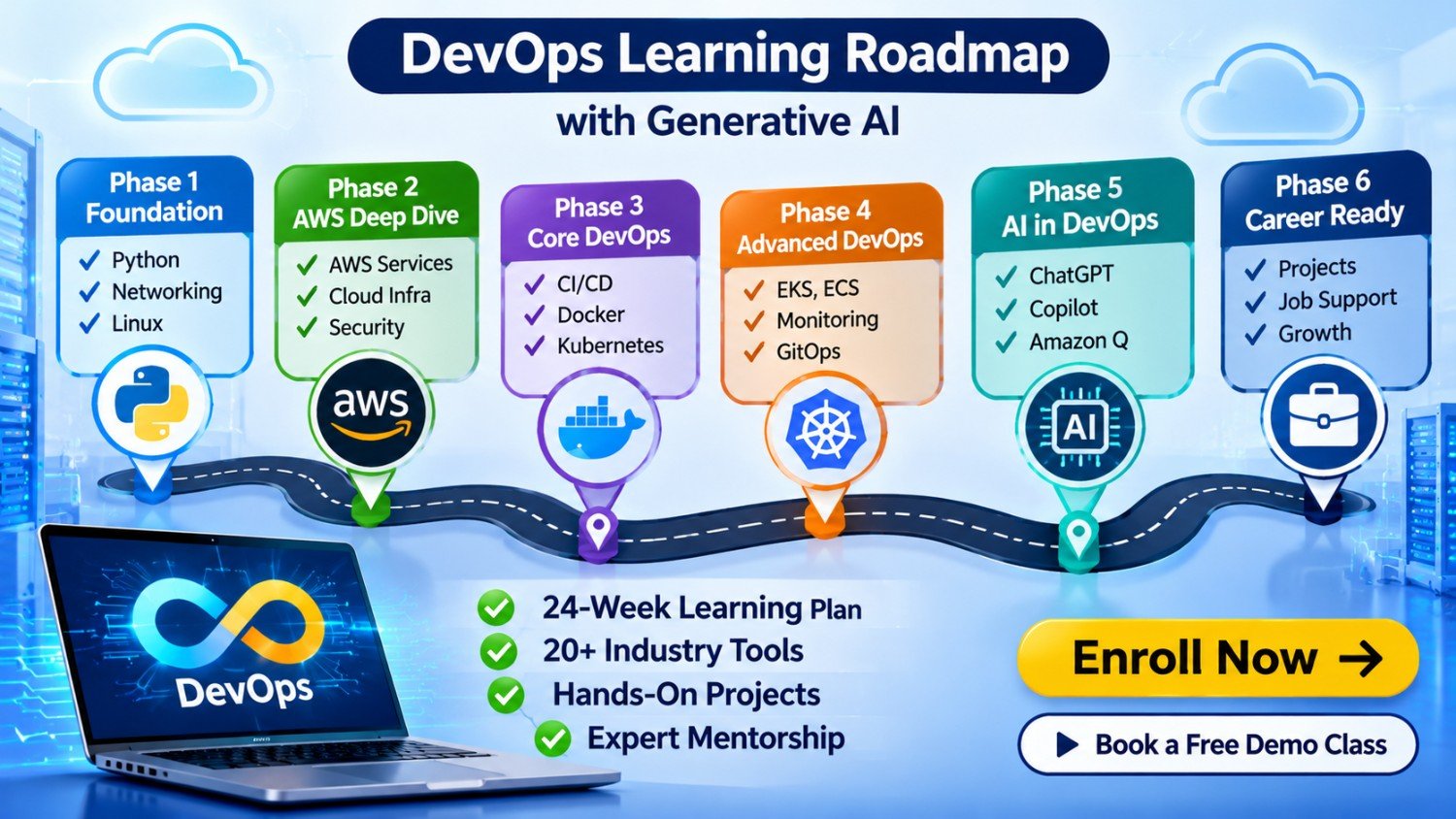
Phase 1: Foundation — Python, Networking and Linux

Before working with cloud infrastructure and deployment pipelines, learners need a foundation in programming, operating systems and networking. Python for DevOps:
  • Python syntax, operators and control flow.
  • Lists, dictionaries, tuples and sets.
  • Functions, modules and scope.
  • File handling and exception handling.
  • Object-oriented programming fundamentals.
  • Libraries and automation scripts.
  • AI-assisted Python scripting using ChatGPT, Claude and Copilot.
Networking fundamentals:
  • OSI and TCP/IP models.
  • IP addressing, subnetting and CIDR.
  • DNS, HTTP, HTTPS and network protocols.
  • Ports, SSL/TLS and secure communication.
  • Load balancing and high availability.
  • Cloud networking and VPC fundamentals.
Linux administration:
  • Linux distributions and file system structure.
  • Terminal commands and file management.
  • Users, groups, permissions and ownership.
  • Processes, services and system administration.
  • Shell scripting and text processing.
  • AI-assisted Linux commands and troubleshooting.
These foundations help learners understand the systems on which cloud applications and DevOps tools operate.

Phase 2: AWS Deep Dive — Cloud Computing and Infrastructure

The next phase introduces AWS cloud computing and the services used to provision, configure and monitor cloud infrastructure.
  • AWS fundamentals: Regions, Availability Zones, cloud computing models and infrastructure concepts.
  • IAM and STS: Users, groups, roles, policies, permissions and identity management.
  • Amazon EC2: Instances, AMIs, EBS, launch templates and snapshots.
  • Amazon S3: Buckets, storage classes, versioning and replication.
  • Amazon VPC: Subnets, Internet Gateway, NAT Gateway, peering and security groups.
  • Elastic Load Balancing: Traffic distribution and application availability.
  • CloudWatch: Dashboards, alarms, metrics and monitoring.
  • AWS Q Developer: AI-assisted code generation, debugging and Infrastructure as Code support.
Practical exercises include launching EC2 instances, configuring IAM access, setting up VPC networks, working with S3 and creating CloudWatch monitoring resources.

Phase 3: Core DevOps — Automation and Delivery

This phase connects development activities with automated software delivery. Learners explore version control, build management, CI/CD, code quality, security and containers. Git, GitHub and Maven:
  • Repository setup and management.
  • Branching, merging and conflict resolution.
  • GitHub Actions workflows using YAML.
  • Build and deployment automation.
  • Maven architecture, POM files and dependency management.
  • AI-assisted build configuration and debugging.
Jenkins and CI/CD:
  • Jenkins architecture and installation.
  • Plugins, credentials and security.
  • Agents and distributed builds.
  • Declarative pipelines and Jenkinsfiles.
  • Shared libraries and delivery pipelines.
  • AI-assisted pipeline creation and troubleshooting.
DevSecOps with SonarQube and Trivy:
  • Code quality analysis.
  • SonarQube scanner and quality gates.
  • Docker image vulnerability scanning with Trivy.
  • Security scan integration into Jenkins.
  • Pipeline checks for critical vulnerabilities.
  • AI-assisted interpretation of security findings.
Docker, Kubernetes and Helm:
  • Docker images, containers and Dockerfiles.
  • Docker CLI, registries, volumes and networking.
  • Docker Compose and container lifecycle management.
  • Kubernetes pods, deployments and services.
  • ConfigMaps, secrets, storage and scaling.
  • Helm charts and reusable deployment configurations.

GitOps, Monitoring and Infrastructure Automation

The programme also introduces technologies used to manage deployments, infrastructure and operational visibility.
  • ArgoCD: GitOps-based deployment workflows.
  • Prometheus: Metrics collection and monitoring.
  • Grafana: Dashboards and visualisation.
  • ELK Stack: Centralised logging and log analysis.
  • Datadog: Monitoring and application performance visibility.
  • Terraform: Infrastructure provisioning through configuration.
  • Ansible: Configuration management and automation.
These technologies help learners understand how infrastructure, application deployment and monitoring can be managed as connected processes.

Phase 4: Advanced DevOps on AWS

After developing core DevOps knowledge, learners move towards advanced container and cloud-native services.
  • AWS Fargate: Run containers without managing the underlying server infrastructure.
  • Amazon ECS: Manage containerised applications using AWS container orchestration.
  • Amazon ECR: Store and manage container images.
  • Amazon EKS: Work with managed Kubernetes clusters on AWS.
  • Splunk: Explore log analytics and operational investigation.
  • Dynatrace: Explore application performance monitoring and observability.
  • AIOps: Understand AI-assisted monitoring, issue detection and operational analysis.
For additional AWS learning information, explore AWS Training and Certification at BinaryBrains.

How Generative AI Supports DevOps Learning

Generative AI is integrated into the programme as a support capability across scripting, cloud assistance, code review, troubleshooting and automation. Learners are introduced to several AI tools and their possible applications in technical workflows.

ChatGPT for DevOps

ChatGPT can help engineers understand unfamiliar code, draft scripts, explain configuration files and organise technical documentation.
  • Python and shell script assistance.
  • Code explanations and debugging support.
  • Infrastructure configuration drafts.
  • Documentation and troubleshooting assistance.

Claude AI

Claude AI can assist with code analysis, debugging, technical explanations, documentation and investigating complex error messages.

GitHub Copilot

GitHub Copilot supports AI-assisted programming through code suggestions, autocomplete and development assistance. It can also help draft scripts and pipeline configurations.

Amazon Q Developer

Amazon Q Developer provides AWS-focused assistance. It can support AWS-related questions, CLI commands, code suggestions, infrastructure guidance and troubleshooting.

Why Verification and Security Matter

AI-generated commands and configurations should never be accepted without review. Engineers need to check permissions, validate generated code, test infrastructure changes and protect confidential information.
  • Do not share passwords, access keys or confidential production data with unapproved AI services.
  • Review generated scripts before executing them.
  • Test infrastructure configurations in controlled environments.
  • Validate IAM permissions and network access rules.
  • Check AI-generated code for security and reliability issues.
The objective is to learn how to use AI responsibly while retaining the technical understanding required to manage real systems.

Practical DevOps Projects and Enterprise Capstone

Learning individual tools is useful, but a practical project helps demonstrate how multiple technologies work together. A strong DevOps training programme should provide opportunities to build, deploy, monitor and troubleshoot applications. DevOps Course With Gen AI – 6 Phases and 24-Week Learning Roadmap
Enterprise Capstone: Healthcare Application on AWS

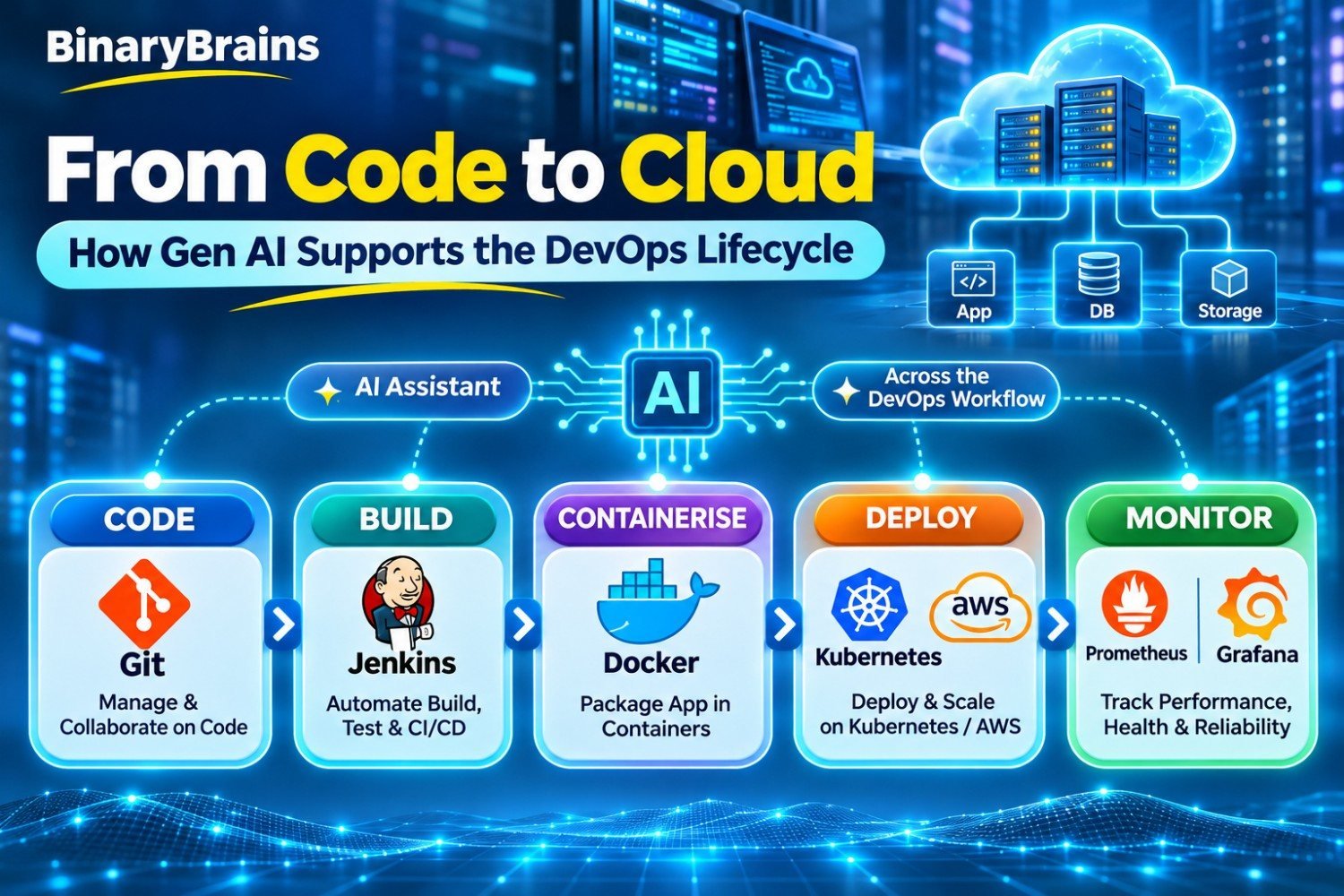
The BinaryBrains programme includes an enterprise capstone project involving the deployment of a healthcare application on AWS using modern DevOps and cloud-native technologies. The project follows a microservices-based architecture and connects different stages of the software delivery lifecycle. Project workflow: Code → Build → Containerise → Deploy → Monitor Technologies used in the project include:
  • GitHub or GitLab for source control.
  • Jenkins or GitHub Actions for CI/CD automation.
  • Docker for containerisation.
  • Kubernetes for container orchestration.
  • Amazon ECR for container image storage.
  • Prometheus and Grafana for monitoring.

Additional Project: Kubernetes Administration and AWS EKS

The programme also includes a practical project focused on Kubernetes administration and Amazon EKS. The project introduces tools and technologies such as:
  • Terraform for infrastructure provisioning.
  • Docker and Amazon ECR for container images.
  • eksctl and kubectl for cluster management.
  • Helm for Kubernetes application deployment.
  • Prometheus for monitoring.
  • Redis as an application data service.
  • AWS Load Balancer Controller for application traffic management.
  • Horizontal Pod Autoscaler for workload scaling.
These projects help learners connect cloud infrastructure, containers, automation, deployment and monitoring in practical environments. To understand the wider programme structure, explore the AI-Powered DevOps Course Syllabus: AWS, GenAI and 24-Week Learning Plan.

What Makes a Good DevOps Project?

A useful project should demonstrate more than a successful installation. It should help you explain the problem, architecture, tools, implementation steps and troubleshooting decisions.
  • What application or infrastructure problem does the project solve?
  • Why were particular tools selected?
  • How is source code managed?
  • How are builds and deployments automated?
  • How is application security checked?
  • How are logs, metrics and failures investigated?
  • What would you improve in a future version?
Documenting these details can help you revisit your project and explain your technical decisions during interviews.

Career Opportunities After DevOps and AI Training

After developing practical knowledge across cloud infrastructure, automation, containers, CI/CD, monitoring and AI-assisted workflows, learners can explore different career paths in cloud and DevOps engineering.

Potential roles include:

  • DevOps Engineer: Works with automation, software delivery pipelines and infrastructure operations.
  • AWS DevOps Engineer: Works with AWS cloud services, deployment automation and cloud infrastructure.
  • Cloud Engineer: Helps provision, configure and maintain cloud environments.
  • DevSecOps Engineer: Integrates security checks and practices into development and deployment workflows.
  • Site Reliability Engineer (SRE): Focuses on service reliability, monitoring and operational resilience.
  • Platform Engineer: Helps build and maintain internal platforms and reusable infrastructure.
  • Cloud Operations Engineer: Supports the availability and operation of cloud-based services.
  • Infrastructure Automation Engineer: Uses automation and Infrastructure as Code to manage systems.

These roles have different technical and experience requirements. Completing a course does not automatically qualify someone for every position. Practical ability, project experience, interview performance and employer requirements all matter.

DevOps Job Assistance and Career Support

Technical training is one part of career preparation. Learners also need to understand how to present their skills, explain project work and prepare for technical interviews.

The BinaryBrains programme describes placement-focused mentorship and career support. The course page also highlights internship opportunities and support for learners preparing for DevOps opportunities.

Resume Preparation

A technical resume should clearly communicate your education, skills, tools, projects and relevant experience. Instead of listing technologies without context, explain what you built, which tools you used and what responsibilities you handled.

LinkedIn and GitHub Profile

A professional LinkedIn profile can help communicate your technical interests and career direction. A well-organised GitHub portfolio can provide evidence of your scripts, projects, configuration files and development work.

Technical Interview Preparation

Prepare to explain topics such as Linux permissions, networking, Git workflows, CI/CD pipelines, Docker images, Kubernetes deployments, AWS services, Terraform and monitoring.

Project-based questions are also important. Practise explaining the architecture, implementation steps, errors encountered and how you resolved them.

Internship and Placement Support

The programme highlights internship opportunities and placement-focused mentorship. Learners should discuss current eligibility requirements, the available support process and the specific terms with the BinaryBrains team before enrolling.

Career assistance can support preparation and access to opportunities, but it should not be interpreted as a guarantee of employment.

Who Should Consider a DevOps Course With Gen AI?

A structured DevOps course with Generative AI can suit learners who want to develop skills in cloud infrastructure, software delivery, automation and modern IT operations.

Engineering and College Students

Engineering students can use structured training to understand Linux, Python, networking, AWS and DevOps tools alongside their academic studies.

BCA and MCA Students

Students interested in cloud computing, software development and infrastructure can build a foundation in scripting, cloud services and deployment workflows.

Fresh Graduates

Fresh graduates can use practical projects to understand how software is built, packaged, deployed and monitored in modern technical environments.

Software Developers

Developers who want to understand deployment automation, containers, cloud infrastructure and operational workflows may find DevOps skills useful.

System Administrators and IT Support Professionals

Professionals with experience in servers, operating systems or IT support can build on their existing knowledge by learning cloud services, scripting and automation.

Working Professionals and Career Changers

Professionals looking to move towards cloud or DevOps roles should compare their current skills with the course curriculum and confirm the expected weekly study commitment.

Do You Need Previous Coding Experience?

The BinaryBrains programme states that prior coding experience is not required and that foundational topics are covered as part of the learning journey.

However, learners should be prepared to practise regularly. A laptop, stable internet connection and consistent participation are important for following technical lessons and completing practical exercises.

Why Consider the BinaryBrains AI-Powered DevOps Programme?

Choosing a training programme requires more than comparing course titles. You should understand its curriculum, learning format, practical work, project structure and career support.

The AI-Powered Master Program in DevOps with AWS at BinaryBrains brings together the following learning areas:

  • 24-week learning journey: A structured programme organised into six phases.
  • 20+ industry tools: Exposure to technologies across cloud, automation, containers, monitoring and AI.
  • Live instructor-led training: Live online learning and classroom options as described on the programme page.
  • Hands-on cloud labs: Practical activities involving AWS, CI/CD, containers and automation.
  • Enterprise capstone: Apply multiple technologies through an end-to-end project.
  • AI across the curriculum: Learn how AI tools can support scripting, code assistance, troubleshooting and operational workflows.
  • Career-focused support: Internship opportunities and placement-focused mentorship.

The programme is described as requiring approximately 6–9 hours of study per week. Batch options, delivery format, current fees and availability should be confirmed directly with the institute.

Read more about the programme on the BinaryBrains AI-Powered Master Program in DevOps with AWS page.

Start Your DevOps Learning Journey With AWS and Gen AI

If you want to develop skills in DevOps, AWS Cloud, CI/CD, Kubernetes, automation and Generative AI, choosing a structured learning programme can help you organise your learning journey.

The BinaryBrains AI-Powered Master Program in DevOps with AWS combines foundational training, cloud infrastructure, DevOps tools, AI-assisted workflows, practical labs and an enterprise capstone.

Before enrolling, discuss your current technical knowledge, learning goals, preferred batch and available training format with the team.

Explore the Programme and Enrolment Details

Review the full curriculum, project information, learning format and career-support details before making your decision.

Explore the AI-Powered Master Program in DevOps with AWS

Want to Understand the Training Before Enrolling?

Join a free demo session to meet a trainer, understand the learning approach and ask questions about the programme.

Book Your Free DevOps Demo Class

Prefer to speak with the team?

Call or WhatsApp: +91-72497 56356

Email: info@binarybrains.co

Contact BinaryBrains

Frequently Asked Questions About DevOps Course With Gen AI and Job Assistance

1. What is a DevOps course with Gen AI and job assistance?

It is a learning programme that combines DevOps fundamentals, AWS cloud computing, CI/CD, automation, containers, Infrastructure as Code, monitoring and Generative AI tools. Career-focused support may also include interview preparation, mentorship and internship opportunities, depending on the programme.

2. How long is the BinaryBrains DevOps programme?

The BinaryBrains AI-Powered Master Program in DevOps with AWS is structured as a 24-week learning journey. The programme page describes an expected study commitment of approximately 6–9 hours per week. Confirm the current batch schedule with the institute.

3. Which technologies are covered in the course?

The programme covers Python, Networking, Linux, AWS, Git, GitHub Actions, Maven, Jenkins, SonarQube, Trivy, Docker, Kubernetes, Helm, ArgoCD, Prometheus, Grafana, ELK, Datadog, Terraform, Ansible, ECS, ECR, EKS, Fargate, Splunk and Dynatrace.

4. Which AI tools are introduced?

The programme introduces ChatGPT, Claude AI, GitHub Copilot and Amazon Q Developer for activities such as scripting, code suggestions, debugging, documentation, AWS assistance and DevOps workflows.

5. Is AWS included in the DevOps course?

Yes. AWS is a major learning area. The programme covers services and concepts such as IAM, EC2, S3, VPC, Elastic Load Balancing, CloudWatch, KMS, Fargate, ECS, ECR and EKS.

6. Can beginners join the programme?

The BinaryBrains programme states that prior coding experience is not required and that foundational topics are included. Beginners should still be prepared for regular practice and hands-on exercises.

7. Does the programme include practical projects?

Yes. The programme describes cloud labs, deployment exercises, automation projects, CI/CD implementation, container orchestration, Infrastructure as Code and an enterprise capstone involving a healthcare application on AWS.

8. What is the role of Generative AI in DevOps?

Generative AI can assist with script generation, configuration drafts, code explanations, debugging, documentation and operational analysis. Engineers must verify AI-generated output and review it for security and correctness before using it.

9. What career opportunities can DevOps learners explore?

Depending on their skills and experience, learners may explore roles such as DevOps Engineer, AWS DevOps Engineer, Cloud Engineer, DevSecOps Engineer, Site Reliability Engineer, Platform Engineer and Cloud Operations Engineer.

10. Does the programme provide placement assistance?

The BinaryBrains programme describes placement-focused mentorship and internship opportunities. Contact the institute to understand the current eligibility requirements, support process and applicable terms. Placement assistance should not be interpreted as a guaranteed job.

11. Are live online classes available?

The programme page describes live instructor-led online training, with weekday and weekend batch options. Confirm the current batch availability and schedule before enrolling.

12. How can I book a demo class?

You can visit the BinaryBrains demo-class page to discuss your learning goals, course curriculum and training requirements.

13. How can I enquire about the DevOps course?

Visit the AI-Powered Master Program in DevOps with AWS page or contact BinaryBrains at +91-72497 56356.

Conclusion: Build Your DevOps and AI Skills With Practical Learning

Modern software delivery brings together cloud computing, automation, containers, CI/CD, infrastructure management, monitoring and security. Generative AI is adding new ways to assist engineers with scripting, code review, troubleshooting, documentation and operational analysis.

A DevOps course with Gen AI and job assistance can provide a structured way to explore these technologies. However, learning tools individually is only the beginning. Understanding how they connect through practical exercises and projects is equally important.

The BinaryBrains AI-Powered Master Program in DevOps with AWS follows a 24-week learning journey covering Python, Networking, Linux, AWS, core DevOps, advanced cloud technologies, Generative AI and an enterprise capstone.

Whether you are a student, fresh graduate, developer or working IT professional, begin by understanding the fundamentals, practise consistently and build projects that demonstrate your technical knowledge.

Explore the programme, review its curriculum and speak with the BinaryBrains team to understand whether it matches your learning goals.

Explore the DevOps With AWS and GenAI Programme

Book a Free Demo Class

Call or WhatsApp: +91-72497 56356

Comments are closed

Enquire About No-Cost EMI
Get details about No-Cost EMI, monthly installments, bank eligibility, and payment options.

🔒 Your data is safe. No spam, ever.

Enquire About the Internship
Get details about internship fees, duration, live projects and mentor support. 

🔒 Your data is safe. No spam, ever.
Please confirm your details